Showing posts with label Waterworks. Show all posts

Friday, November 30, 2012

No.6 Inventing The American Bathroom with Barbara Sallick of Waterworks

Who: Barbara Sallick
What: Waterworks -
The Destination for Artisanally Crafted Bathroom Products
When: Since 1978
Where: It began in a warehouse in Connecticut and now has showrooms internationally
 
To call Barbara Sallick delightful may be an understatement. Her voice barrels through the phone lines excited, energized and as enthusiastic about design today as a newly hired architect might be at their first job. She is flipping through an early copy of Gil Shafer's latest book The Great American House and relishing his talents and each detail she hones in on.
"Gil really is so talented." She says; you can just tell she is smiling and leaning over the glossy pages.
And she would know. Barbara has been the leading force behind what has come to be The American Bathroom Style. Brilliantly designed and meticulously crafted, Waterworks has changed what it means to have quality, beauty and excitement in a room that has often been undermined in the home: the bathroom. And as any truly successful craft or product for the home, this one was born out of a necessity.

 
A glowing assortment of Waterworks fittings.
Plumbing- perhaps not the most coveted utility of the home, but one that is functional, necessary and non-negotiable ever since the Romans first designed and implemented it. The distribution of water to and from buildings was no small feat and certainly not one that was mastered right away. As with any invention the trial and error of many a material came and went. Earthenware and timber failed the meeting the challenge when it came to implementing the various designs, sizes and geometry of these envisioned water systems. But then someone tried using lead to create a water distribution system. The dawn of the first plumbing standard was set when various apparatus' were fitted, jointed and worked out in lead. The word plumber itself derives from the Latin 'plumbus', or 'lead'. A big idea, exposure to building and design and lots of experimentation got it all going.

'Etoile exposed thermosaic shower system, unlaquered brass'

So, when a man named Samuel Gorgins started and ran The Nutmeg Plumbing Supply Company in Danbury, Connecticut in 1925, he may not have realized that his sheer knowledge, love of his family and exceptional skills at business would lead to yet another dawn in the evolution of water's relationship to a building (the home especially). And he would, as he had a very smart, curious and artistically inclined daughter named Barbara. 
"He [Samuel], his brother and his sister oversaw the company throughout Norwalk, Greenwich, Danbury [Connecticut]... I don't know how they managed but they started it and managed to keep it open through the War." Barbara Reflects. "He was alright as an engineer but a very good businessman. So my husband Robert [Sallick] joined the business in 1963 to help him out."
The Clothilde all hand polished, free-standing copper bathtub is made in the 19th Century French tradition, both in design and artisanal manufacturing method, but with a new regal scale and immeasurable elegance.
It's one thing to become familiar with the work one's parents do, but if you come from a family business it is all the more likely one might help out, work there part time, or, like many, perhaps fully go into and work at the family business full time. Regardless of which of these one might engage in, a sort of default education is cultivated sheerly from exposure to the business.


A sneak behind the scenes into the Waterworks Design Studio
So Barbara certainly had her fill of knowledge about the plumbing supply world, and so did her husband Robert, after beginning to work there full time. But this wasn't the only knowledge they shared- Barbara and Robert also shared an affinity for the American Decorative arts and architecture. 

"We've really always been collectors at heart." Barbara says warmly, "And I have always had a childish passion to look for new houses." she laughs, noting that while she and Robert have lived in the same house for 43 years, they became enamoured with 18th Century architecture and still love to tour historic houses open to the public in rural Connecticut, Massachusetts and beyond- emphasis on beyond.
"We're nosey!" Barbara laughs, "Shortly after we married we began taking regular trips to Europe, and wanted to get into as many buildings as possible to have a look around..."
Which is also no surprise, as Barbara had a hunger for discovering details in design, which, alongside the base knowledge of her father's business, was cultivated in a more formal education during her time at Yale. For over 6 years she had worked at a Yale art gallery where she assisted and oversaw a wide array of collections of American Decorative Arts. She absolutely loved being there and came to see the importance of maintenance, size, color, material, style... what it meant to create something that would stand the test of time.

A Waterworks white and taupe bath set.
As Barbara and Robert continued their sporadic trips through Europe, Barbara was of course more and more intrigued with the European bathrooms she was seeing.
"There were a lot of changes happening in the 1970's" Barbara recalls. "There were the waterfall faucets, and Villeroy & Boch were doing some interesting things..."
But Barbara and Robert had some new ideas about the bathroom. Sure, we all had the option to perhaps pick a color for our shower curtain and towels, our toilet or bathroom tile- but the quality of the choices available weren't enough. And they certainly weren't as personal as they should be. Furthermore- why not white? Keeping things white, spacious and with an Edwardian aesthetic, as Barbara had so often seen done in Europe, offered a new perspective to The Bathroom as Barbara had known it, and it seemed Robert agreed... And so, with enough pooled knowledge and passionate research, Barbara and Robert Sallick founded a new bathroom-devoted company in 1978.
"To help us get started my father gave us 1 year free rent for a section of his warehouse where we could set up shop." Says Barbara. "And it was my job to get the architects to our showroom to show them what we were doing."


Design Development Sketch of handle for Waterworks new R.W. Atlas collection
And they liked what she and Robert were doing- so did the general American public, who became enamoured with the new style they were seeing. This endeavour offered a completely new set of aesthetic options to use when designing (or redesigning or renovating or even envisioning) a home. Not to mention (finally) raising the bar of design in the bathroom while concurrently reviving the definitive standards of European craftsmanship. They had pooled together their knowledge of architecture, design, art, art history, plumbing, plumbing supplies, engineering, craftsmanship and materials all to create something that would officially set a new standard for bathrooms; especially as they were offering expertly crafted products made with exceptionally outstanding and luxurious materials. They were beginning to not only develop products that were completely reliable and functional, but that were also aesthetically superior to any bathroom products that were on the market. (Today Waterworks has grown all the more by offering a very full array of products from fittings and fixtures, to furnishings and surfaces.)
Some of Waterworks favorite Raw Materials
For example, some materials of many products on their website today range from: nickel, silver, bronze, copper, brass, chrome, metal, carbon or gold-- oh yeah, and those materials may each have options of finishes such as: antique, matte, shiny, burnished, lacquered, unlaquered and so on.

And such a visual astuteness and attention to detail came from both Barbara's exposure to the nuts and bolts of the industry but also from those many years working at that Yale art gallery.
"There's something you learn from experience with a three-dimensional object," Barbara says "I spent a lot of time taking things apart and putting them back together."
And this experience and appreciation for hands-on learning ripples throughout the company today. As Waterworks grew over the years, and was finally given a name (the Sallick's threw a dinner party with close friends asking for help brainstorming- one of them came up with Waterworks and Barbara knew that's it!), they continued to make sure they only worked with the finest manufacturers. And how else to do this other than to partner with some of the finest artisans throughout Europe and America?
"We seek out small talented artisan(s) outfits and work with them to teach them how to manufacture on a larger scale." Barbara says.
A Waterworks Artisan works in his shop to cast and forge meticulous gold hardware. Later it will be carefully retouched and hand polished.
She, and her son Peter Sallick, who joined their team in 1993 and now serves as President and CEO of the company, work together to seek out these artisans. Together they are searching for experience and quality, rather than criteria (as most crafts are taught generationally or via apprenticeship and hands on work- not through a college degree). Whereas some of their faucetry may come from a shop in Normandy, France, other hardware and furnishings may be made in a variety of allied shops here in New Jersey, New York, California... Which makes sense, considering how thoughtful each product, selected artisan and employee in the company is. When asked about working with her son, Barbara replies enthusiastically: 

Sultry color comes out in Waterworks' District Tile Collection

"Peter's eye, taste and extraordinary abilities as a visionary and a strategist make it an exceptional collaboration. But also I think it's a part of our strength as a whole that we say: Family First."

Peter Sallick has helped take Waterworks to the next level, offering a complete range of services for a complete bathroom. The Sallick's seem to know talent when they see it, as well as how important it is to uphold and maintain it in the design industry. Everything in Waterworks, from selecting materials, overseeing the design process and carefully controlling manufacturing has been and continues to be undertaken with meticulous care and attention to detail.

A Waterworks Surface Template

Furthermore, what makes Waterworks beautiful, aside from the products themselves, is that by continuing to seek out and partner with small shops and studios to manufacture their products, they are keeping a small and important pool of artists, artisans and craftspeople alive and well (the world always needs more art, and value of it, this is a rare field and place where that can happen). Even if some of the products may be out of your price range, the products, designs, textures and color pallets serve as a new set of precedent images to work from when creating and personalizing your own bathroom.

Over the years, becoming something of an expert on it, Barbara Sallick has continued to be none less than thrilled to continue developing and cultivating superior bathroom aesthetics. If you still aren't sure where to begin, or the countless ways to imprint your personal style and tastes into your bathroom, you can always follow her on The Perfect Bath, Barbara's personal design journal and blog. She cares deeply about the relationship between a person and their personal space and goes to great lengths to fuse her experience in this unique field and share it with one and all so you might benefit too.

Aside from carrying on and discovering new and old design styles everywhere to create something new, Barbara does want to leave anyone- experienced or new to design- who wants to improve their bathroom with these words of wisdom:
"Plan well, be sure to do your homework and lots of research- on the web and in libraries- and be sure you hire a true professional to work with. [When you are ready] Engage knowledgeable sales people and don't be affraid to ask questions. Hire a good architect and contractor and stay on top of them- this way you'll own the outcome."
The complete R.W. Atlas Collection makes its launch!
A shot of Waterworks' 58th Street Showroom showcasing the new industrial inspired R.W. Atlas Collection alongside its complimentary sibling the 'District Tile Collection'.
Barbara Sallick is the Co-Founder, Executive Vice President and spokesperson of Waterworks [Opertating Company, LLC]. She is the author of Waterworks: Inventing Bath Style as well as her ongoing blog The Perfect Bath, in which she shares her insights. She sits on the Board of Directors at the Institute for Classical Architecture & Art and still lives in her home in Connecticut with her husband Robert, and frequently travels overseeing Waterworks new endeavours.

Monday, July 30, 2012

No.2 Mixing It Up with Dana Berkowitz of Hacienda Design Studio


Who: Dana Berkowitz
What: Hacienda Design Studio - Cement Remixed
Where: Nation-Wide 
(and soon to be Internationally)
When: They launched just this year, and are already on fire


One afternoon in Yucatan's Historic District of Merida, Mexico, not so long after the last hammer and drill were packed up and the final contractor left, Dana Berkowitz sat in the uncanny quiet of her newly restored mansion drumming her fingers together slowly. Sitting on the edge of the couch, unsure how to relax just yet, she realized she'd done it, she'd accomplished her dream of restoring her very own beautiful, historic home in Mexico. The 1840's carriage house she'd bought in ruins just a few years before was now her very own pristine, restored historic home. Her drumming fingers came to a stop. 
"I literally remember looking around and the first and only thing I could think of was: now what?"
The restored Yucatan home with original cement floors
Dana's gaze landed directly on the colorful cement tile floor in front of her. She'd looked at it a million times, it was, afterall, the only part of the original house from the 1840's that was completely in-tact among the ruins when she bought it. She'd always enjoyed the colors and how the cool, smooth cement made sense in Mexico's hot, tropical weather... Then Dana looked a bit closer. And well, the rest, they could say, remixed history.


Being intrigued by the beauty and durability of the tiles in her own home, and what she was noticing more and more in her surroundings, Dana began to do her research. Over two centuries ago cement tile made its way from Europe (Dana notes, most likely France) to Mexico where it grew in popularity and was quickly utilized as a regular part of building and decoration.  
Cement floors during restoration in Yucatan
Making a mental note of cement tile around Merida and beginning to visit multiple shops where cement tile was made, she found that the utterly versatile and durable material her floors were made of was relatively simple and straight forward to produce, and even better, it was green. 
"Not only did the tile in my 170 year old house last nearly two centuries, but during the restoration, ceilings and walls were demolished right on top of the unprotected cement floors. When the rubble was carted away the floors were polished and still looked fantastic. And then I find out that on top of all of this: it's eco-friendly and LEED certified."

As the pebbles of inspiration began taking shape (and color) in Dana's mind she found herself talking to more people about cement tile and eventually asking some of the local shop and factory owners she was meeting in Mexico if they would work with her on some designs she had brewing. 
Some of HDC's original dried color samples up close. 
Much to her disappointment, not many were interested. Why change and grow? Things are fine as is... Challenged with the mellow thinking that can be found at times outside America's encouraged high-speed individualism, Dana sighed, but did not stop. She kept mulling things over in her head. 


Dana was no stranger to what a refined design aesthetic looked like. Prior to her journey to Mexico she had worked in the architecture + design industry at Pierre Frey, and for ten years as a Senior Design Consultant at Waterworks  in [New York City's] Midtown location. With all the knowledge she had from her years in design, and now as a freshly minted home restoration veteran, 
Espresso from the side
she was starting to see all the elements of design coming together- she was beginning to see a much bigger picture. 


A lover of Mexico and the aesthetic of their traditional tiles, she knew for certain she did not want to replicate what has already been artistically mastered there. However, she did absolutely want to utilize the green, brilliant and simple manufacturing process she had now seen produce a product that could stand the test of time...
"It was very important to me to maintain the ancient handcrafted techniques, but not mimic or repeat the magnificent array of historic patterns already available. [What] I was intent on reinventing [was] the Look of cement tile...
HDS' Sydney pattern adorns new counters at NYC's Salon Hecho.
"I wanted to develop a modern, focused color pallet, going away from the typical rusts, greens and yellows- trying hard to pick the perfect greys, taupes, blues- and create simple modern designs that would work as a collection and fit more contemporary architecture and design. This way any space can have cement tile, not just historic, Spanish colonial spaces."
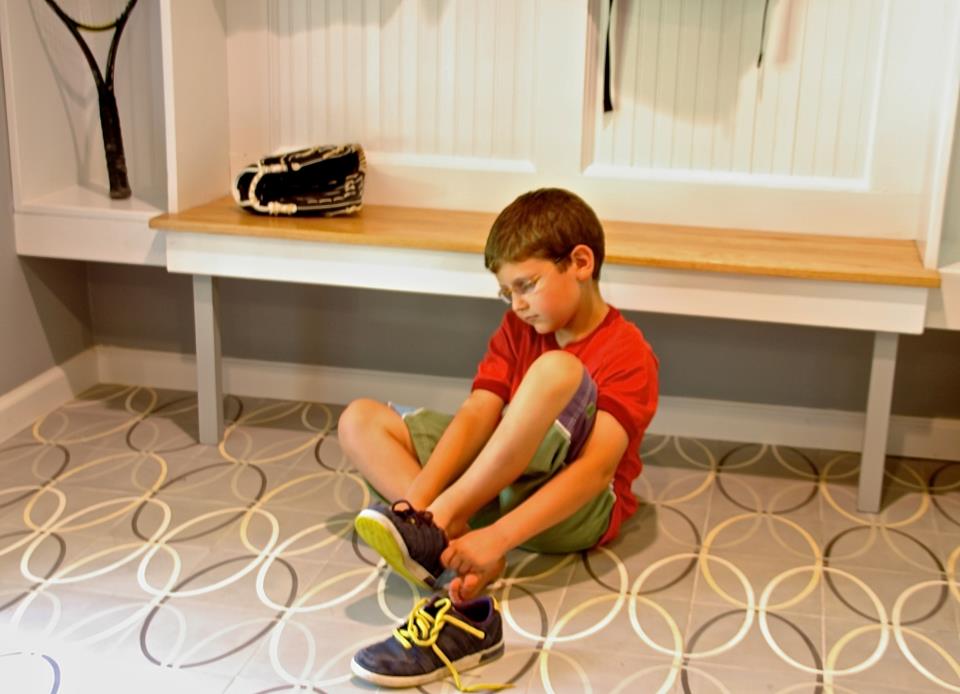
A playful use of HDS' Monaco pattern adds a jovial sophistication to a children's 'mudroom' and never gets ruined!

Metal frame and template for the Prague pattern
The original craft of making cement tiles, mixing and hand pressing each layer, remains relatively the same today as it did in its beginnings. It is a three part process wherein three cement mixtures are layered atop one another, each hand pressed so all moisture is extracted, and the final tile is let air dry for 21 days. Today the only real difference in this process is the optional use of a hydraulic press, which might expedite the process just a tad.
Cement in various pigments are mixed prior to their pour.
"Once the tile maker pours the cement into its respective sections, he or she places each tile into a hydraulic press with 1700psi to aid in the compression and elimination of moisture." 


A craftsman in Vietnam smooths moisture out of a tiles second layer.  


The final product was a tile that would last a lifetime and sustain a buildings character and story for generations to come, not to mention at an extremely modest price tag for the quality of the product. Dana wondered how many historic American buildings lost their luscious details and decor to time and poor upkeep- 'but imagine if they had been done in cement tile...', she thought, 'Perhaps more of the past could have naturally been preserved...' This was a product too good to let go without trying her hand at it. 
Cannes in Cloud + Sky


While Dana continued to play with colors and design ideas that were growing steadily into a cohesive collection, her search for a factory she could utilize to make her new cement tile vision come to life continued. Now also beginning to plan her trip back to the Big Apple to take on what would soon become Hacienda Design Studio,  Dana booked a meeting with a long time, trusted colleague of hers to get some feedback. She was blown away by the positive response and support of her designs. And she was even more taken when confiding in her colleague how
A craftsman works with custom colors and layers in a tiles frame
hard it'd been just to find a place she could utilize for manufacturing, her colleague relayed that in Vietnam they actually had many factories that were utilizing the same techniques she saw used in Mexico to create cement products. And there it was, just the piece of the puzzle she needed to get started. It turns out that a factory half-way across the world from where she had first explored cement tile was making it in the exact same quality, character and technique.


Bruges in Cloud + Thyme
So at this point, Dana had taken a bit of the Old School of the Mexican cement tile craft, designed an entire collection with modern, sophisticated colors and designs, found a top- notch manufacturing facility in Vietnam and still wasn't done earning the already poignant sentiment behind the company's slogan: Cement Remixed. She brought the New School all the more by implementing technology via Hacienda Design Studio's most incisive feature: The Mixer. This is one of my favorite features that truly brings the renewed cement tile vision and energy full circle- everything is customizable. You are not limited to a collection as merely as Dana saw it (granted we definitely like what's there!), you can re-envision it again and again yourself. You can play with the tile/ pattern of your choice, the tile size, the colors in each detail of the patterns you see on the screen (and save them privately or publicly for viewing) and
Bali in Marina, Bark, Cloud, Pebble + Pumpkin
arrange each of them in a different manner, offering a totally different shape to each pattern (or in solid colors, mind you!). This feature allows the collection to expand beyond what is shown and serves as a key tool to the revitalization of cement tile's possibilities to be used anywhere. Thanks to Hacienda Design Studio we all now have a new resource for both residential or commercial decor that is a green product, water and fireproof, can be used indoors and out, for walls, ceilings and beyond (the product's only limitation is in outdoor use in a freeze/thaw climate- it's the only time cracking is a risk); and all for a modest price. The tiles are only the slightest bit thicker than an average ceramic tile, and are better for a buildings overall durability.


HDS cement color samples for a mix + match session
 Whether you yourself are redoing your entry foyer or your architect or interior designer is redoing your summer home or bathroom, The Mixer allows for a premeditated and well thought out design process that inherently gives one the time and space needed to creating a beautiful outcome. It's true that one could feel inspired and get sucked into The Mixer just for fun, but a trained eye might also find a place to successfully create a custom masterpiece all their own. 


Thank goodness Dana took on her lifelong dream of restoring a historic home all her own in Merida; now we can all enjoy and appreciate her journey into a renewed vision for cement tile. I don't know about you, but I can't wait to see what she has in store next!
Left: Provence tile prototype, Right: A cement rug designed with a Provence field and Vienna Border in Pebble, Shadow, Lily, Sky + Cloud.

HDS' Yolanda Lewis shares about finding inspiration everywhere, including stellar photography. Drawn to the movement and colors of the photo [left] she went into The Mixer to create a beauty of her own [right] with HDS' Seattle pattern.


Hacienda Design Studio officially launched itself in January 2012, it's website in May of 2012 and has since been featured in the Stylist Home section of the Huffington Post. Their product is in use in numerous projects still in production and can be seen completed in Salon Hecho's new NYC digs. To order samples, tiles or to learn more about Hacienda Design Studio you can visit them at: www.HaciendaDesignStudio.com or follow their Blog.