Showing posts with label Architectural Details. Show all posts

Tuesday, January 28, 2014

No. 11 Creating Objects of Desire with Jean Paul Viollet of Atelier Viollet


Who: Jean Paul Viollet
What: Atelier Viollet
When: Founded in France in 1836 and Revived 
In New York City 150 Years Later 
Where: Based In New York City
Servicing Projects Internationally

It is not just anyone who possesses the gift of creating a literal object of desire. Thumbing back through time, through an infinite catalogue of mythical objects, it remains a consistent theme that they were all coveted for their innumerable powers, all surely divinely inspired. Be it their beauty, the enchanting materials they were made from, the process of their forging or preordained purpose- these objects cast a spell over all who encountered them even in rumor. 

A stunning Night Table in Horn + accented with Staw Marquetry.
 But today, encountering such a spellbinding object of desire is far from a mythical rumor. As a matter of fact, it is likely we've found one of the last standing artisans who may be able to recreate Pandora's Box or the chest holding Jason's dear Golden Fleece - his name is Jean-Paul Viollet, of Brooklyn-based Atelier VIollet; where all the artisans employed seem to have the Midas touch.

Jean-Paul Viollet was born with craftsmanship and curiosity is in his bones. The decedent of a long line of dedicated artisans, who began Atelier Viollet in Seyssel, France in 1836 (which thrived and then subsided only to be revived by Jean-Paul in the USA in 1986), was something of a necessary calling he simply could not ignore-
"I grew up in my Father and Grandfather's wood-shop, I was naturally immersed in the field;" he recalls, noting the other interests he cultivated over time like mechanics and photography,"but when I moved to the USA at 24, something happened and I just realized that furniture making was it for me..."
A breathtaking original desk takes shape in Palmwood, Mica and Patinated Bronze.
 And thank goodness. Atelier Viollet is a distinguished gem of a studio, focusing on fine cabinetry and detailed furniture- specializing in the use of rare and exotic materials. Even if some the materials weren't unheard of, what makes them priceless is the ways they find to use them. Whether in unaltered application or a wildly inventive new use, a simple piece of wood or straw, a chunk of gypsum dug up from the earth's core or a blank canvas of sheep-skin is transformed and given a new name at the hands of Jean-Paul Viollet. Applying traditional techniques, modern technology, incredible planning precision and an abundance of imagination Jean-Paul continually oversees the creation of pieces of work that more closely border art than home furnishings. 


A wall made up of hand made Straw Marquetry panels.
 Surely creating a these treasures is not a cheap undertaking, but that also seems to be part of the outfit's philosophy, in a way stating- 'We are being trusted to create something priceless, intimate and meaningful- and we are dedicated to doing it immaculately'. These custom furnishings or cabinets, these superlative details are not meant to be temporary, they uphold the age old ideal that to own something is to have invested in something worth keeping.
"A Custom piece of furniture is by definition a unique object." He states plainly. "It is satisfying to create but its ultimate goal is to fit in a specific environment for a specific person- it will become property of that person and most likely a unique relationship between a human being and object will be created." Jean-Paul states matter-of-factly. "A good piece of furniture can bring calmness and joy."
An Atelier Viollet original J.M. Frank inspired desk in Oak and Leather.

And what if we all held the objects we bought and used to decorate in such high esteem? Or made a point of not buying the cheapest of the cheap home fixtures and boasting about them (only to have to replace them 6 months later)? Would this level of attention to detail better inform a persons relationship to the home? To the work we do to provide for that home? Perhaps the integration of traditional Craftsmanship's principles into everyday life would embolden and enrich our experience. Would we become more curious about the details all around us? The workings of Atelier Viollet seem to beg these questions further when we see the application of a thoughtful and thorough process create such bespoke products.
An Atelier Viollet Artisan works intimately with Oak to gauge it  by hand and apply it to a library's interior.
The Gauged Oak millwork and detailing comes to life when installed in this custom library for G.P. Schafer Architects.
Paired with the masterful use of tools and a craftsman's eye, is also the extensive research process, knowledge and use of materials. From parchment to gypsum, shagreen to horn, or lacquers to mica or straw marquetry, Atelier Viollet has taken pains to continue investing time and energy into the research of materials available in the world and taking the time to intimately learn and understand the ones they obtain. 

"The Hands of Jean-Paul Viollet" campaign holding Shagreen.
 "Shagreen is one of my favorite exotic materials." says Viollet, "[It's] technique has traveled through centuries and both the scale of its use and the different polishes that can be used on it are incomparable." 

"I introduced Water Buffalo Horn to our list of techniques and materials a few years ago, and it's been greatly favored for it's richness and resilience." He notes.
An Atelier Viollet Artisan reviews Parchment stock before work.
 One of the great joys for Jean-Paul which fuels so much of his work continues to be the process-creative and technical- as much as the product, which naturally comes through in the studio's work. Merely by looking at a finished piece of his work, one can almost envision him staying late to play with the materials, and taking great joy in discovering and rediscovering them all over again. 

He notes they have recently completed a project they are particularly proud- a Park Avenue study fully adorned with Parchment detailing, part of the full renovation of the apartment. Atelier Viollet has certainly done wall treatments with this material before, but nothing quite like this- 

"We covered all the walls in sheep-skin, including all of the doors and crown mouldings." He says excitedly, "Treating all curved areas and going all the way technically. It was a great challenge and an incredible result. It's a jewlery box."
Which is a wonderful way to think of a room- as a jewlery box, filled with inspiring, beautiful delights. And this is something that this Artisan has inspired us again to think about- just how important it is to stop and give attention to the details. Jean-Paul himself notes, if there was any message he could send to the architectural and design community, or the world at large, it would be:
"[To] Appreciate and respect all work done by hand...In this fast-paced world I only hope we'll be able to perpetuate craftsmanship. It's so important." 
Indeed it is. Our goal this week is to stop and look at the details all around us, to consider how things are made; and in turn, to consider how we can make them better. 
Atelier Viollet gives this dining room Parchment walls.
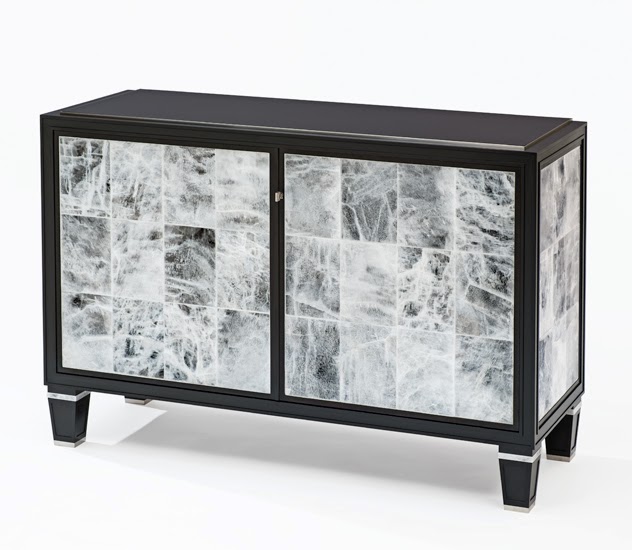
Another stunning Atelier Viollet original, this cabinet is made up of gypsum, ebonized Pear-wood and silvered bronze.
Atelier Viollet has been featured in numerous design publications including New York SPACES, New York Magazine, House & Garden among others. To learn more about them and what they do, please visit AtelierViollet.com. Their Brooklyn-based studio and showroom are available for visitation by appointment only.

Monday, May 20, 2013

No.10 Reflecting On Beauty, Art and the World of Eglomise with Miriam Ellner

Who: Miriam Ellner
What: Miriam Ellner Design - Verre Eglomise
When: Since 1990
Where: Based In New York City
Servicing Projects Internationally

If somehow, among your travels, when the stewardess stopped serving and the plane's cabin slept, you stayed awake to stare out the window at the eerie quiet of the ever-delicate clouds, and caught the rarest of moments between time and space, where the restless angels had abandoned their posts, and saw a glimpse of the pearly white gates rumored to be the entry-way to heaven; well, we're fairly certain, after the shock and awe of witnessing the perfect ether, looking closely enough, it's altogether likely we'd find the gates themselves were a Verre Eglomise masterpiece made by the hands of Miriam Ellner. 


22 karat gold-leaf polychromes make up this set of 3 Neoclassical wall panels by Miriam Ellner Design.
We assure you, if it sounds far fetched- it isn't. Even upon entering Miriam Ellner's Chelsea-based studio in New York City there is an ambiance of celestial bliss - especially for those with a deep appreciation of design and fine arts. In modest size the all-white room is illuminated with large, open windows and clad with stunning pieces of hand- crafted verre eglomise gems. From small square tiles to full scale entryway panels waiting for shipment, every piece of work has been meticulously tended to and contains an astonishing array of depth, emotion and beauty. 


What, you may ask, is verre eglomise? It is an ancient craft of custom glass gilding, wherein gold, metal or a myriad of other materials are applied to the back of a glass panel which show through to the front of the glass with the seamless quality of a
painting. After any variation of basic gilding application, the delicate leafing can be manipulated further with the simplest of tools to create imagery as rich as that of a drawing or painting. As a matter of fact, that's how many of these pieces begin.  
"I've always been something of a 'visual collector'." Miriam reflects on her career, a montage of eglomise samples floating like pictorial thought bubbles behind her. "I love doing research. I think books were one of my first loves."
Miriam Ellner has had a rich journey in the arts. Evolving all the way from her childhood affinity for the library (beginning her own collection of visual references even then) into the world of modern dance and even whirling through the realm of costume and set design, Miriam doesn't ever seem to cease learning. When she
A remarkable sample of a 4-layer laminate piece Miriam Ellner Design
is currently working on for a European Residence. It is part of what
will be 2 large panels for a set of doors- talk about inspiring.
 happened to stumble upon the Van Der Kelen School for artisnal crafts in Brussels she was mesmerized by the old world ambiance of the buildings and ateliers, so she followed her fancy and applied to be accepted the following year. (1985)  It was here that she got grounded in her new studies and received the formal training in decorative arts that would set the ball rolling to her current career today. It was at Van Der Kelen she learned gold leaf and eglomise. And she loved it so much, when she returned to the US, she returned a decorative painter. 

"I'm a risk taker." Says Miriam shyly of making her start in a new field and craft, "I made a list of the best [design] talent I wanted to work with and went after them. I only wanted to work with the best."
But often a new career or talent needs a push, and Ellner found herself at the hands of a high-end builder who was enamored with her work and made a point of helping introduce her around. 
An example of eglomise detailed furniture/ plated inlays
Miriam Ellner Design did with designer Michael Simon
"I used to go around to meetings with these little 2x3" samples of my work;" she laughs, insisting on bringing one out to show a small eglomise sample the size of a business card, "just to show something to designers I met." 
Which seems funny, upon looking at the vast array of samples and completed projects she's now surrounded by in her studio on a daily basis. But it was upon one fated meeting with renowned interior designer Robert Metzger that officially set her new path ablaze. Miriam still recalls showing Mr. Metzger her small samples and seeing the wheels turn in his head.
 "He just got it." she smiles, "[He] commissioned two tables with me and that was the start."
A favorite precedent image, Miriam finds herself inspired by the art of eglomise
being found as far back as 200BC, as with these bowls from Canosa, Italy
Since then Miriam Ellner seems to've taken the industry by storm, even earning herself one of the Institute of Classical Architecture & Art's prestegious Arthur Ross Award's for Artisanship this past May. Either quietly or quite boldly, her work can be found among the projects of some of the design industry's top talent. After many years of sharing her vision of eglomise being brought back to the settings of projects everywhere, Miriam has also contributed to the age-old art by infusing some of her own style and expertise into her work. Her refined skills, well rounded viewpoint and inherent humility come through in her work with grace and confidence- but also some gusto; almost delicately saying 'that's lovely, but I'm going to push the envelope now'. 
A series of 7 eglomise glass panels in Jean Dunand style, composed of 22 karat gold leaf, palladium leaf, mica flakes, abalone and polychromes.
Miriam's long time business partner and development director, Wiley Kidd, notes 
"What makes Miriam such a master of design in her own right is that few people have pushed eglomise as far as she has." he admires, "She knows when to be restrained and when to push boundaries; instead of doing a small door inlay, she'll say, 'let's try the whole room'. People don't do that enough."
Turns out design risk takers and grand talents are indeed a perfect fit for Miriam's interest in bold style, here she pairs
with the grand talent at Kemble Interiors for Kips Bay Decorator Show House 2011, doing a whole ceiling in eglomise
Forget looking around the rest of the Show House, this ceiling for Kemble Interior's room is worth parking on
the couch to look up and admire.
And it's worth pushing boundaries. A craft like this that can be so masterfully honed can be utilized endlessly in design. Why not enrich more spaces by having artwork like this built into it? 


Color and depth stun in eglomise in these panels of 22 karat gold, mica
powders and polychromes for a private residence's powder room.
 As Miriam continues nourishing and growing her work and technique as well as her studies in the arts, it seems the only natural her next step is to learn through teaching- which she'll be having a hand at this Fall. Over the years she has also attended Dale Chihuly's exquisite Pilchuck Glass School on scholarship, as well as the Corning Glass Studio, just to expand her knowledge on materials and craft further. So after having years of putting her knowledge and talent to use, this fall is just as excited to be giving back, teaching a class on verra eglomise at the Society of Gilders Conference in New Orleans, Louisiana during the week long program of round tables, classes, lectures and exhibitions by experts in the field; an endeavor her schedule won't usually permit, but which she's made priority. 


Miriam starts a new piece by applying gold leaf to the back of a panel
As Miriam reflects with gratitude on the rare career she's created and has the pleasure of continuing on a daily basis, she reflects on the importance of eglomise to design, or perhaps just of art to the world:
"The idea of creating beauty is profound. I recall being at a Matisse show once and just being completely taken aback by how much beauty he contributed to the world." Miriam bats a glassy eye, "Forgive me," she smiles warmly, moved even by the memory, "Not to say that I'm Matisse!" she laughs. "But the thought of being able to contribute any kind of beauty to the world is one of the most fulfilling things I can do- and this for me is my form."
Well, we're glad it is. The world can certainly always use more of the thoughtful, intricate and distinguished details art brings to it. And if design is continuing to be enhanced by details like that of Miriam Ellner, we'll certainly be staying tuned in. 
"A series of verra eglomise glass panels in the style of Dunand, designed to line the walls of a dinning room above the
dado. Made up of 22 karat gold leaf, palladium leaf, various precious metals and polychromes."
Eglomise enriches a kitchen backsplash with this vignette. Made up of 22 karat gold leaf, mica powders & polychromes.
"A series of verra eglomise glass panels designed in neoclassical style, to line the walls of a dinning room.
All panels executed on full restoration glass and assembled like a Chinese puzzle. Made up of 22 karat
gold leaf, palladium leaf, tarnished silvers and polychromes."
Miriam Ellner Design has been featured in neumerous design publications, including Architectural Digest, Elle Decor and even on the Martha Stewart Living Show. She is a member of the Institute for Classical Architecture & Art, and was the 2013 Arthur Ross Award recipient for Artisanship. To contact her New York based studio or learn more about what she does please visit miriamellner.com.