Showing posts with label Architectural Ornamentation. Show all posts

Thursday, January 31, 2013

No.8 SPECIAL GUEST: Architectural Designer & Author of The Art of Classical Details Phillip Dodd Shares on Artisans, Art & Architecture


Portrait By: Peter Olsen
Who: Phillip J. Dodd
What: Architectural Designer & Author of Upcoming Knockout Publication
When: The book is due out March, 2013
Where: A Native to Manchester, England he now lives and works in Connecticut
 
We tend to fancy every guest we feature here at Artisanal Specs. quite special indeed. Alas, keeping with our promised sub-series of 'Special Guests', we are honored to share our first very special guest interview and book review with none other than the renowned architectural designer, artist, historian, writer, educator and expert on classical design: Phillip J. Dodd, author of upcoming knockout publication The Art of Classical Details: Theory, Design And Craftsmanship. Aside from giving us a tour behind the scenes of The Art of Classical Details, Phillip also gives us a thoughtful and incisive look into his minds eye. With a passionate take on architecture and a healthy dose of that warm British humor, Phillip shows us how integral it just might be to maintain a well-rounded and all-inclusive discussion of what goes into creating contemporary classical architecture.  
 
In keeping with Artisanal Specs.' love for and focus on the artisans, trades and specialty craftspeople that work thoroughly alongside architects, designers and builders to bring design to life, there is good reason we were so excited to cover The Art of Classical Details. Unlike many of the other wonderful books out on design, from the perspective of architecture, Phillip has worked with tender and extensive care to curate a publication that tells the story of contemporary classical architecture and design from the in-depth and multifaceted viewpoints of architects, designers, artists (himself), scholars and artisans and craftspeople; an opportune and rich perspective we do not often get to hear. With his own craftsman-like precision, Phillip has carved out a space to facilitate a discourse on design from an elevated and uniquely all- inclusive point of view. He brings to the table a pallet of voices that paint a larger picture of how and why it is worth carrying out the principles and practices of classical architecture in the modern world. Before we totally dive into our talk with Phillip, here's a shortlist of some of the incredible talents and minds you can expect to hear from in this book: David Easton, Henry Hope Reed, Quinlan Terry, Ken Tate, Dinyar Wadia, Richard Carbino, Foster Reeve, Peter Pennoyer, Richard Cameron, Mark Ferguson, Oscar Shamamian, Jeremy Musson, Alain Oliver, Robert Adam, Paul Chesney, Julian Bicknell, Anne Fairfax, Richard Sammons and so many, many more.
 
As you may have gathered by now, we love to begin by asking our features why they do what they do and what their journey has been in the field. So when we sat down to talk with Phillip we knew we liked him already when he replied to our 'So Phillip, why architecture?' with:
"I saw The Towering Inferno as a kid and wanted to be Paul Newman." Pause. We both laugh. "I love drawing. Since grade school technical drawing was my best subject..." Phillip shifts to sincerity.
"Drumlin Hall, Dutchess County, NY, Peter Pennoyer
Architects" Pg 188, as seen in TAoCD, The Projects.
And therein lay the start: drawing. The Art of Classical Details came to fruition at the hands of someone who began with the arts and was drawn to the space architecture created where both art and mechanics, the creative and the logical minds, were coming together.
"Architecture is a funny subject. It's both artistic, but it's also technical. There's a rigor to it. You have to be very mathematic, to be able to have that kind of mindset- but you also have to be artistic and able to draw..."
Phillip, who hails from Manchester, England, where he attended both the Manchester School of Architecture as well as studying architecture at the renowned Prince of Wales Institute of Architecture in London (and that's just before he came to the States, where he would gain his Master's in architecture from The University of Notre Dame), has spent quite a bit of time studying architecture. If there's one thing he has grown passionate about it is the necessity to have a well rounded understanding of both the fine arts and mathematical/ analytical, to be able to comprehensively create accurate and good architecture.


Fluted Doric column with modillion block entableture by
John B. Murray Architect, Pg 10 as seen in TAoCD.
 Aside from the experience Phillip got in school, especially the Prince of Wales Institute, after being convinced by a friend to travel to the U.S. and just try working here for a while, he got his dose of training at the hands of Fairfax and Sammons co-founder, Richard Sammons. Back when the firm was going by Richard Franklin Sammons Architect, and there were only 5 people in the office, Phillip received dedicated and insightful instruction from Richard each day- an experience well worth the stay. As the firm grew and the tides shifted, Phillip found his way to Connecticut where he joined Dinyar Wadia's renowned team of designers and builders (where he continues to work) at Wadia Associates. After his many, many years of study and exercise, Phillip found Dinyar was glad to let him unleash his talents and practice architecture as he knew it.
"Richard [Sammons] taught me, and Dinyar [Wadia] allows me to practice what I've learned..." Phillip reflects.
What Phillip wound up receiving in his journey, turned out to be something of a rare, modern day apprenticeship in architectural design, an experience that may be leaning toward rarity. Which is not to say, however, that merely having the experience of working with top architects and designers themselves doesn't also offer it's own education. Phillip likes to give nod to this by noting that the realm of designers in each generation come from something of an organic family tree in design, offering an innate 'trickle down of character', each with it's own inheritance of knowledge and then offshoot of new creativity (just have a look at those who've spun from the offices of Parish Hadley or Robert A.M. Stern and how those experiences and teachings of hands on work has informed their disciples...).

Today, with so many leading schools focusing on the use of the computer to design spaces, it has become easy to stray from the importance of spacial interpretation and the focus drawing inherently facilitates, taking away from a building's ability to be a relatable space to the people who use it. (We understand this debate, as per which is more influential, people>buildings, buildings>people, can be controversial, but let us hear out this side for now).
A bespoke fireplace designed by Allan Greenberg, as seen in TAoCD
"I think today, with all the use of computers for design, you have people who would have at one time gone into engineering or computer programming, instead going into architecture. But in architecture you really have to have a combination of lots of both artistic and analytical..." Phillip notes. "When I went to architecture school in England we didn't have computers, you had to take with you a portfolio of your artwork, to show them that you could draw. That was most important for admission into architecture school."
When posed with the question as to whether or not he might consider himself an artist as well as an architectural designer, or if he thought architecture itself to be an art form, Phillip recalls poignantly that during his time at the Prince of Wales Institute one of the widely elected studies that was imperative in the coursework was a life drawing seminar, where the students would sit and draw nudes- twice a week, mandatory. An answer to these questions could simply be yes, but it's not so simple (as the arts never are), and Phillip won't let it go at that, as architecture is multifaceted, and never one-sided. He notes that part of the importance of continuing to develop and nourish those skills cultivated in drawing nudes, is the necessity to understand the human form, in all its "ergonomics" and proportions. 

"Apprentices at SYMM ’s workshop are trained in the traditional
skills of specialist joinery and cabinetry, finish carpentry,
painting, decorating and polishing." Pg 19, as seen in TAoCD
"Buildings are spaces people live and work in, if you don't understand people, how can you have a building that works?" Phillip asks. "A building isn't just a series of details, some of those details have to evolve as you grow to understand what you're creating, the various hierarchies and proportions..." 

A good point. It isn't about producing a series of pretty drawings to then move forward and capitulate into a building, so much as studying potential and then fusing that with a wide range of data, geometry, analysis and technical details. Phillip notes that while yes, architecture is an art form, perhaps architects are more like artisans than artists, in that they maintain that fusion between the two minds to create the real and true finished product that tells a story.

Phillip notes that while he prefers the voice of classicism, it isn't because modern architecture inherently 'isn't' or 'can't be' good, so much as that there may be (or often tends to be) an underlying dissociation between the study of the human experience and form and a building. He notes it is not just about shape or size, but also material, texture, color...all the things that go into shaping a space. Classicism is more about traditions than merely about history, as Phillip likes to emphasize. For him, an ideal experience in designing a house is not about recreating some historical precedent merely to have it spat out of time in a new location; it is about the process of listening and learning and applying traditions of architecture to a customized design.
"I'm not a big fan of telling people what to do, or how to live their lives. I don't like it. I think people inherently know what they want." Phillip notes. "...There's a big difference between liking something and appreciating it."
He goes on to discuss how if you listen carefully to people, they design their homes for you. It shouldn't be a mystery where the rooms are from the outside of a building, and each room should sensically speak to the home-owners life and lifestyle, desires, wants and aesthetic expression. Traditions, he believes, are not to be thrown out, but upheld and learned from along with the new; and in creating The Art of Classical Details, Phillip has gone to great lengths to show a wide range of how Classicism can be applied and utilized to continue to foster innovation. Classicism should perhaps (and certainly could) serve as something of a tool-set for achieving the best outcome.
"There's no work in the [book] that I don't like. Each project featured is a great design- whether it is my cup of tea or not, I cannot sensor based on my own aesthetic tastes... but I appreciate all of it. And that's why it's in the book."
Julian Bicknell stuns with "Henbury Hall, Cheshire, England, Julian Bicknell & Associates" as seen in TAoCD, The Projects


Phillip's own training and insights into creating classical architecture today keenly informs his decision to include essays by artisans themselves within this book. Often one may think of an apprenticeship as a one-on-one training and transferring of knowledge and skills from a 'master' craftsperson, usually with a building material, to another; but as Phillip received something of this kind of training himself in architecture (and art), he understands that the artisans and craftspeople are just as integral in design as the architect. Which may be why there was not a question or moments pause to his desire and feeling that their voices were just as necessary in the chorus to having The Art of Classical Details' ring true in a proper ode to classicism today.

"Fluted pilasters with delicately detailed Corinthian
capitals Peter Pennoyer Architects," as seen in TAoCD
Phillip notes that the reason artisans are so important (just as much today as any other time prior in history) is that they embody the complete fusion of building and art in what they do. Each craft with its own specialized background and palate of materials, provides a highly trained understanding of the smallest of details. Only a true artisan understands the direction, shape and size a single leaf should have in a rinceau as well as the depth, shadow and proportion any one section of ornament with all its parts so that it upholds the utmost artistic integrity but also maintains balance and perspective within architecture. A true artisan has a sixth sense for the process of taking a design from an artistic rendering phase to a sketch with thoroughly plotted out measurements (and their correct scales), and then the artistic mock-up, material selection and fine tuning of a single section of work (for any one single room). No small order indeed... worth looking deeper into, don't you think?
"You know I remember, there was a publisher when I was in school, Andreas Papadakis I believe, yes he published Academy Editions, a series of small architectural monographs by some of the top classical architects around," Phillip recalls, "and you know, they were fantastic. That was in the early 90's... And I haven't seen anything like them since..."
 
Indeed, these Academy Editions were a rare series of monographs that were wonderful and highly insightful, and at times a bit academic, but were mostly projects and not so much writing. Even these gems were missing the inclusion of the craftsperson.
 
"Outstanding craftsmanship means using traditional techniques, whether that be hand carving or
forging steel on a blacksmith’s anvil. These are labor intensive and highly skilled processes for
which there is no substitute. Chesney’s" Pg 246 as seen in TAoCD.
"No craftsmen were featured or anything like that. I don't think there's ever been a book actually where the craftsmen have wrote;" Phillip says, "it's always been scholars and architects who have written...but [in the book] I wanted there to be a lot of voices... I tried to fill in the gaps... It really is a great group- scholars, architects and artisans all mixed in. And artisans... artisans, who have never been asked to write anything before."
 
But Phillip has, and boy to they have some fantastic things to say. We're thrilled. It is a trail blazing effort to fuse the old with the new even in terms of a more traditional formula to creating a book on architecture. What makes the book special is not only the range of experience, perspective and talent in design that shares their expertise, but also the thoughtful lens through which each offers their own personal fondness for this effort and encouragement for the conversation to continue.
"You never see those close ups in books anymore," Phillip says about architectural detailing, "and we need to keep these crafts alive."
 
Between the countless years of design expertise and personal insight shared in this one of a kind homage to classicism, we believe that The Art of Classical Details may be proving to be an important tool for the new and future generations of designers, artisans, scholars and architecture aficionados alike. The book has just gone and created it's own history simply by providing a space for so many voices to come together and speak. (Who knows what this could mean to a student who didn't even know how a plaster mould was made or what it could be made into? Or if they wanted to find a better way than AutoCAD to approach a building?) All this said, we will certainly be keeping tabs on Phillip as he moves on and continues to discuss architecture in all it's grandeur, but in the mean time, we'd start by just strongly recommending you grab yourself a copy, have your own experience with this wonderfully thorough and incomparably beautiful publication, and find out more about what classical architecture in the modern world means to you.
"Ferne Park, Dorset, England, Quinlan & Francis Terry Architects," Pg 198, as seen in The Art of Classical Details.
"The dining room is decorated with Gracie handpainted wallpaper that compliments the highly detailed door casings and ceiling crown. Eric J. Smith Architect." Pg 12&13 as seen in The Art of Classical Details.
And again we say, congratulations Phillip J. Dodd and The Art of Classical Details: Theory, Design and Craftsmanship, on a job very well done!
 
Phillip J. Dodd is a Senior Architectural Designer and Marketing Director at Wadia Associates in New Canaan, CT. He is also the author of New Classicists: Wadia Associates, which features a foreward by H.R.H. The Prince of Wales and Introduction by Paul Gunther, President of the ICAA. You can read much more about him and his work here. A list of book signings, lectures and events will be posted within the month, and the books official release date is March 16, 2013. You can also connect with Phillip and The Art of Classical Details on Facebook.


Wednesday, October 31, 2012

No.5 A Rare Species - G. Michael Merritt of Merritt Woodwork Shares On A Legacy of Excellence


Who: G. Michael Merritt
What: Custom Architectural Woodwork
When: Since 1972
Where: Based in Ohio, Florida + Connecticut,
Services Projects on Land + Sea, Internationally 

George A. Merritt was an utterly dedicated man- a man that sought perfection above all else. Little did he know that his own personal talents, along with his uncompromising work ethic and high standards of knowledge and quality, would set sparks flying and ignite a unique flame for refined, superlative architectural woodwork.
"His talent was in educating and working with his hands;" Reflects George's son, current Merritt Woodwork CEO G. Michael Merritt, "he always wanted to start his own business, but he didn't know what..."
A Merritt Woodwork hand carved floral ornament.
Always handy, and interested in design, George A. Merritt had also begun training under an Italian master cabinet maker- which soon proved a good fit. Not long after quickly mastering new skills of his own, George A. Merritt and his mentor decided to begin their business in 1971; just the 2 of them providing outstanding custom products. One of their strengths from the start was also the ability to draw. As drawing and sketching provided a unique service to potential clients, George soon became something of a developer. Realizing he could work and engage with designers in a rare way, serving as an interlocutor between the moment an interior designer or architect began describing their ideas and and his ability to sketch them out in the shop. Between he and his mentor, George began providing artisanal abilities to American designers in his humble Mentor, Ohio shop.

Mahogany: egg + dart, Acanthus leaf, ornament
These designers often needed him to put these ideas on paper, drawing by hand, so they could work together to capture the details, have them approved on paper so George could flawlessly move forward with their creation. He would then gladly take these approved drawings to the shop and he and his partner would work their magic in making them real.


A Merritt Woodwork custom carved capital in White Oak.
So the sparks had struck up a flame and the game was on- the vision of a highly focused, quality cabinet and millwork outfit had begun. Yet, as George A. Merritt desired to truly house a solid business, he began looking for other talent to join their team. As he began to hire in the late 70's- early 80's, he could see that those that were truly talented were already of age, which was fine for the   moment... But being a keen and thorough businessman, he'd already pinpointed that there weren't many young people in the business and began to ask himself: 'well what am I going to do in 20 years? I cannot just rely on my sons...' And it was through this foresight he made the executive decision to take the path of teaching and educating to grow the company slowly and meticulously over time. He wanted to find high energy people that genuinely wanted to be there and were interested in the trade. And he did. He began to work with people who grew into their talents and were devoted to the team, turning around higher and higher quality cabinetry and millwork as they went.

Merritt gives this parlor's architectural woodwork detailing a white lacquer. Design by Scott Snyder, Inc.

Down the line, George A. Merritt's mentor and original partner decided he didn't was a bit less interested in the business, and opted to let George take it down the new path it was headed. And so it went, spending the days on the shop floor getting dusty from drawing shop plans and working with wood, and dusting off to spend the evening going to dinner and meeting his future clients and designers, all in an effort to truly build something special.

Hand Carved Mahogany Rosette by Merritt
And he did. Merritt Woodwork has grown into what is today an organization of over 150 highly trained artisans and craftspeople, installers and engineers. They have serviced remarkable projects for some of the design industry's most coveted names- Robert A.M. Stern, Bunny Williams, Scott Snyder and the late Albert Hadley to name a few.
"All of my first jobs were in the shop, since I was in junior high." recalls Michael, "And [my] Dad was very stern, no handouts, no nonsense, everything you got you earned. He laid a very structured foundation and installed a strong work ethic in all of us- had everyone complete a 5,000 hour work-training program when they joined the team." 
After years of watching his father work and grow his company, and slowly becoming more and more involved himself, Michael began to consider that perhaps this really could be something for him to do. There was a huge satisfaction in working with designers to orchestrate the undertaking of a custom woodworking program. Besides, Michael jests,
"After enough time around the smell of sawdust, I think it grows on ya'."
Merritt puts it's masterly finishing touch on this dining room with a white lacquer, design by Scott Snyder, Inc.
Another white lacquered masterpiece; design by Scott Snyder, Inc.
But there's more to it than that. We've had the privilege of seeing Michael in action, making his thorough presentation of wood's possibilities to some of today's most coveted addresses, and he may well be underestimating his own passion for wood in architecture and design. You can tell in his presence and intensity that he demands excellence in craftsmanship , engineering and installation, and nothing less, to bring his clients designs to life.  He alone holds a wealth of knowledge to various wood species and types, custom finishes, veneers, and even which architectural vernaculars and geographic locations might benefit best from various materials. He is just as thorough as we imagine his father might have been.


"I suppose due to my English heritage I've always had an affinity for Mahogany, which carves beautifully." Says Michael, reflecting on some of his personal favorite materials. "And Walnut Cherries and Maple woods are also beautiful American woods; but since so many of these trees have been decimated with so much of them wasted, they are harder to come by in solids. So [we] still use them, more sparingly, for veneers."

After 30 years of building a successful company with a sterling reputation, passing his affinity for strategy, beauty and craftsmanship on to his sons Michael and Keith, George A. Merritt passed in 2001. It was right at a pivotal moment in Merritt Woodwork's company history, having progressed just enough for a new level of expansion, and it was at that time Michael and Keith Merritt decided to grab hold of the reins and let her lead the way.

Merritt stuns with this custom globe with hidden compartments.
Merritt Woodwork has grown from servicing high end residential projects with it's astounding abilities (and even custom creation of home furnishings for their projects) and has also moved into not only retail and corporate environments, but also marine environments. Yes, you heard that right, Merritt Woodwork also provides their talent to enhancing yacht joinery, furnishings and living environments. Michael himself has always been a fan of sea life and saw an interesting opportunity to expand Merritt's abilities there. One of his favorite hallmark projects in this new realm was working on Cakewalk: a mega-yacht of luxury, has been the largest to be built in the U.S. since the 1930's.

Cakewalk: 281 feet long and 2,998 tons is grand indeed.
 "It was really a moment of pride for us," says Michael, "we were very involved with the preliminary development and the outcome was beautiful."

Another one of the many ways Merritt Woodwork has since grown into the unique powerhouse of woodwork it is today, has been in utilizing technology and fusing it with highly trained craftspeople it employs along with other trained artisans as well. (One of their favorite artists Merritt sometimes collaborates with is Master Carver Ian Agrell.) Of course with programs like AutoCAD and various new machines to assist with handling and roughing out large quantities of wood (followed by hand carving and touching up), Merritt Woodwork employs an even more exceptional technological tool to their package of services: climate controlled workshops and vehicles.

Being thorough in every way possible, Merritt is also dedicated to being just as economical with time as they are with detailing. Many millwork outfits can struggle to provide timely delivery on job sites or installations as the seasonal humidity, temperature and geographic location affect the expansion and contraction of wood. Michael has pointed out that if the workshop is finishing detailing a project in Ohio in August for September delivery and installation in New York or California- both the climate of the shop and the project location will affect the size and measurements of the material. The best way to avoid being incorrect on sizing or potentially holding up a schedule because they can't install until the wood goes back to the correct size, is to make it and deliver it in climate controlled environments. This way, when the project is ready for them, they arrive and deliver the pre-completed product via refrigerated vehicle and install it first thing. The result is flawless excellence that lasts for lifetimes to come.

This residence gets a Merritt Woodwork finish with an authentic, rustic use of wood.
So aside from all we know now about what a thorough, comprehensive woodwork experience can be for a space, should one choose to work with an outfit like Merritt; we know just how dynamic even more details of design can be. This company has truly taken the age-old crafts of wood, addressed and premeditated all of it's pros and cons, and found solutions to be able to apply its beauty everywhere. And we're glad- now that we've seen wood and millwork intelligently utilized and applied properly, we can be aware when we're not having it done right.

When we ask Michael finally, if there was anything he would like to leave us with, anything he'd like to say to the world about his craft and company, he pauses thoughtfully and says:
"Really, more than anything, I wish I could energize the enthusiasm for woodwork in trades and design, and encourage it's use. It's a special craft. One that never stops being beautiful."
Thanks, Michael. We totally agree.
Merritt Woodwork utilizes Makore wood to bring this modern residence to life. Architecture by Jeffery Berkus Architects
Merritt Woodwork enriches this lush dining area with cerused White Oak. Design by Scott Snyder, Inc.
Merritt Woodwork has worked on projects featured in Architectural Digest, Robb Report, Bunny Williams' Point of View: Three Decades of Decorating Elegant and Comfortable Houses, and many more. You can learn more about them at www.merrittwoodwork.com, or contact their headquarters in Ohio: 440.220.7816.

Friday, August 31, 2012

No.3 Written In Stone- Richard Carbino Talks Classical Stone Carving Today with Traditional Cut Stone


Who: Richard Carbino
What: Traditional Cut Stone, Ltd.
When: Since the Earth was created, and Man first carved stone
Where: Toronto, Canada 
+ services projects all over North America


Richard Carbino is vivacious, fun-loving, always enjoys a good laugh- at first glance you might not guess he was deeply passionate about stone and one of the leading forces behind what is today, home to the largest existing studio of classically trained stone carvers in North America. 

Inspired and moved by art and architecture all over Europe and the work of Gian Lorenzo Bernini, Richard pursued his own training as a Journeyman Mason under Danish Master Mason Knud Norgaard in Kingston, Canada.
"It's funny though, aside from my love of the craft, I had a foreman on a job once tell me I talked too much and maybe I should work in sales," Richard laughs, "well..."
On November 11, 1999, their hearts aflutter with hope and optimism, three men gathered and set out on a mission to preserve the history and beauty of an irreplaceable art. Richard Carbino was one of these three, along with David Tyrrell and Lawrence Voaides, who officially founded Traditional Cut Stone, Ltd. Their utter love for stone, art and architecture would not be in vein, they would preserve it's place in architecture and design for as long as they possibly could. 
"It was a day to remember, indeed." Says Richard.

TCS rendering for a stone fountain.
Traditional Cut Stone, Ltd. specializes in upholding the classical elements of 
stone carving in architecture, preserving a certain integrity, honesty and high caliber element in building that isn't as easily found as one might think- they preserve and protect the art in architecture. Not just the final outcome, but the process of its creation.

As we've learned here once before, with Foster Reeve, another advocate of the classical design and creation process, there are numerous components that go into expressing a superlative design correctly. Richard and his team take this no less seriously. For them, however, the preservation of this historically heroic process is necessary as they are in the business of creating history-
TCS custom Corinthian Capitals made of Indiana Stone adorn these columns.

"Think about it, stone is the oldest, most widely used building material on the planet. To conquer natural stone- to shape, carve and build with it- it makes you feel like anything is possible. And its inherently organic quality and sense of permanence are both awe- inspiring and humbling at the same time."


Michelangelo Bust in Carrara Marble
It's one thing to make sculptural  art work out of stone to stand alone, but Richard notes that the combined effectiveness of stones durability and aesthetic enhancement of adorning a building that makes its use in architecture and design so breathtaking. So when I ask him quite simply why, aside from the challenge it provides, stone matters; why is it important to have classically trained artisans and stone carvers participate in architecture and design in 2012, Richard doesn't have to think for a moment-

"For the same reason that opera, classical music and ballet matter. Without the arts there is no culture. Without culture there is no love. Without love, there is no life."

TCS 20,000 sq ft atelier in Toronto, Canada.
Customized, hand crafted creations that come out of Traditional Cut Stone's 20,000 square foot atelier in Toronto, Canada are indeed pieces of art. The process each project undergoes is thorough, and fuses the articulation of old methods with a few the newer technologies to help expedite the process. 

TCS phase one of a tympanum.
When a client and/or designer comes to Traditional Cut Stone with a project, they bring a vision. This vision is one that is shared with Traditional Cut Stone's team and artists to begin. After an in-depth round of research and sketches (to assist in creating the most historically and artistically correct image possible), the artist will develop sketches into more lush renderings which are then submitted for approval. These drafts may begin on a small scale, but they do also get printed out to their full scale for initial design development to begin. 

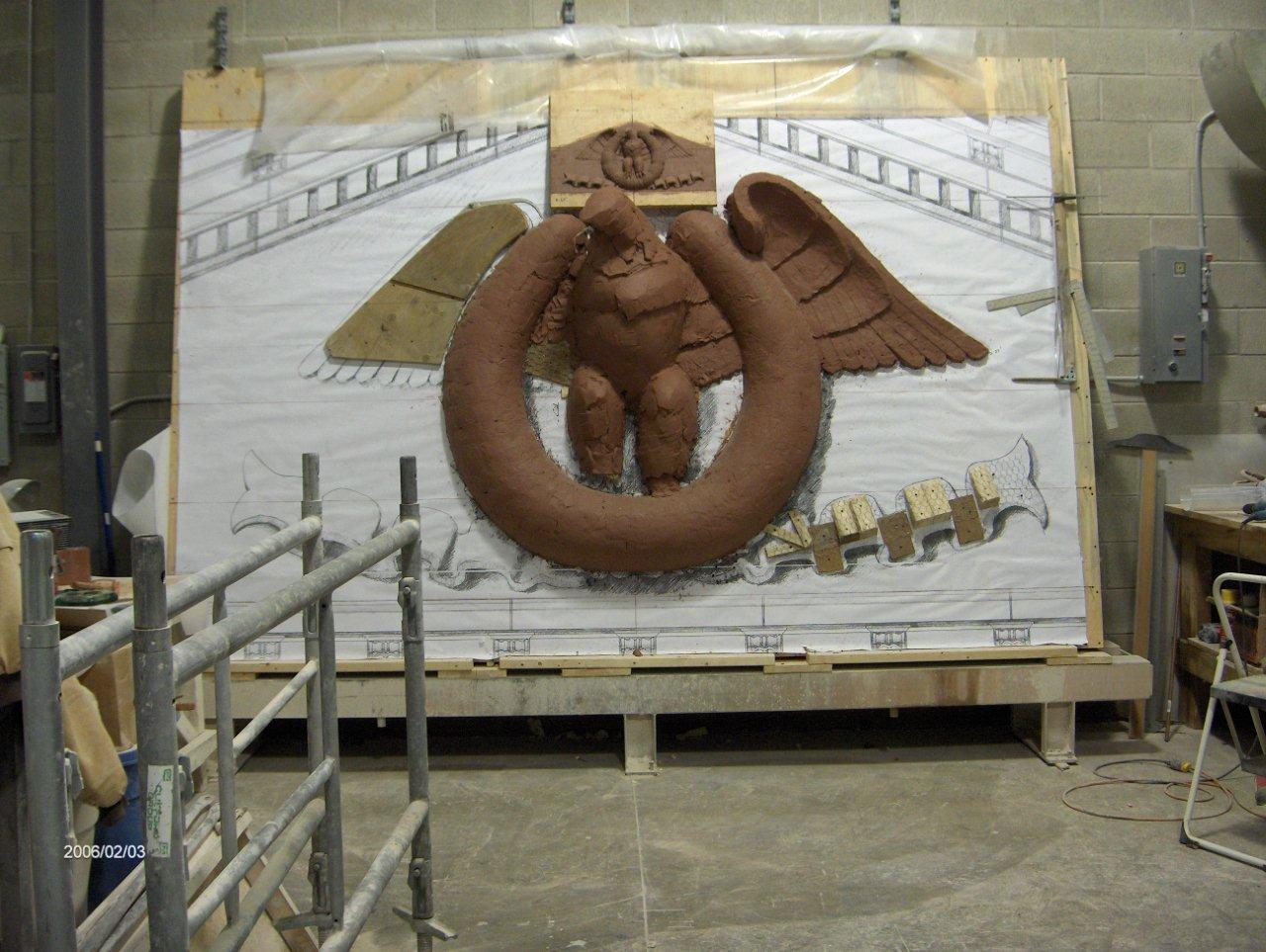
The above rendering of a building's tympanum with an eagle sculpture is taken to the next phase, with the image printed to it's actual scale, and the beginnings of it's sculptural actualization.
The tympanum's ornamentation and sculpture continues to take shape at it's intended scale.
A close up on some of the near complete detailing of the tympanum's eagle and bay leaves sculpture- you can watch a seriously awesome slideshow of the process here as well.

Also similar to Mr. Reeve's process, when a rendering is approved, a sculptor begins to work out a mock-up of the piece at hand with clay, and later is also molded in plaster. While some of these elements of preparation are being addressed and perfected, Traditional Cut Stone will also work with the design team and artisans to select the right natural stone for the piece. Sometimes, this can be challenging as there is such a wide variety of stones out there to choose from, and depending on the project- be it a balustrade, a specially commissioned bust, a full range of facade ornamentation or a fireplace- selecting this material is crucial. After all, once it's done in stone, it really is there forever.
An occulus window surround carved in Minnesota Limestone
"I'd have to say that Stone's are really just like people- some of good character and some of bad character... The trick is knowing which ones to invite to your dinner party." Richard jests. 

"It all comes down to fitness for use; it depends on the stone type. Some sandstone's and limestone's are good for exterior use, and some aren't. [Although] my favorites would include: Carrara marble  for figurative statuary; and limestone or sandstone for architectural ornamentation."

TCS artisans hand carve + chisel stone ornamentation.
 When a stone is selected and all of the details of the 3 dimensional clay mock-up have been approved, a plaster cast of the clay sculpture is taken. This plaster cast provides as a fully accurate model for the artisan to work from as they begin stone cutting and carving.

Traditional Cut Stone, is in fact, extremely loyal to the tradition of stone carving as it's been passed down through history. The entire process up until this point remains relatively the same as it was in he 14th Century, with the exception of using AutoCAD to electronically compute dimensions to scale of the final product. 
An air hammer is utilized to smooth out carved details.
They may also use a CNC (Computer Numerical Control) machine to assist with cutting down extremely large pieces of stone to a geometrically (and proportionally) manageable size to begin the work by hand; or an air hammer to assist with smoothing out  sections of a piece of stone. Utilizing today's technology to assist with the ancient process of stone carving with a chisel, mallet and hammer, helps cut down on time once spent on labor intensive activities (like cutting down a massive chunk of stone to the size you need), and leaves that time to be spent focusing on the artistry.

Traditional Cut Stone has actually shown that technology has helped to maintain an age old process that requires no technology at all. While creating architectural details with stone can seem a lengthy process, it seems it should be, for it is the process itself that is preparation for something that will last for generations to come.(If you look up synonyms for 'permanent', you're likely to find phrases such as 'set in stone' for a reason- stone lives on past us). 

The eagle, tympanum and architectural ornamentation are settled into their new home.
It makes one wonder just how much more time we should be devoting to so many aspects of our lives. Richard, David and Lawrence didn't care about the trends of the times when they gathered together to create Traditional Cut Stone (the use of numerous alternate materials in the 1970's nearly wiped stone off the menu in building) they were devoted to preserving the craft, integrity and process that goes into creating spaces of meaning which we inhabit. These men have created a space for the love of art, materials and architecture can foster one another and grow.  It nearly seems overwhelming to think of just how much goes into creating pieces of history now. Alas, Richard reassures me it is not impossible to participate and appreciate art, architecture and stone everywhere:

"Look up! Look around you! Study the architectural stone where you live and wherever you may travel. By doing so you will be paying homage to the men and women that have literally carved mankind's  history in stone."
Now this is the sort of underlying philosophy and ethos that actually should be set in stone. Thanks, Richard.