Showing posts with label Gypsum. Show all posts

Tuesday, January 28, 2014

No. 11 Creating Objects of Desire with Jean Paul Viollet of Atelier Viollet


Who: Jean Paul Viollet
What: Atelier Viollet
When: Founded in France in 1836 and Revived 
In New York City 150 Years Later 
Where: Based In New York City
Servicing Projects Internationally

It is not just anyone who possesses the gift of creating a literal object of desire. Thumbing back through time, through an infinite catalogue of mythical objects, it remains a consistent theme that they were all coveted for their innumerable powers, all surely divinely inspired. Be it their beauty, the enchanting materials they were made from, the process of their forging or preordained purpose- these objects cast a spell over all who encountered them even in rumor. 

A stunning Night Table in Horn + accented with Staw Marquetry.
 But today, encountering such a spellbinding object of desire is far from a mythical rumor. As a matter of fact, it is likely we've found one of the last standing artisans who may be able to recreate Pandora's Box or the chest holding Jason's dear Golden Fleece - his name is Jean-Paul Viollet, of Brooklyn-based Atelier VIollet; where all the artisans employed seem to have the Midas touch.

Jean-Paul Viollet was born with craftsmanship and curiosity is in his bones. The decedent of a long line of dedicated artisans, who began Atelier Viollet in Seyssel, France in 1836 (which thrived and then subsided only to be revived by Jean-Paul in the USA in 1986), was something of a necessary calling he simply could not ignore-
"I grew up in my Father and Grandfather's wood-shop, I was naturally immersed in the field;" he recalls, noting the other interests he cultivated over time like mechanics and photography,"but when I moved to the USA at 24, something happened and I just realized that furniture making was it for me..."
A breathtaking original desk takes shape in Palmwood, Mica and Patinated Bronze.
 And thank goodness. Atelier Viollet is a distinguished gem of a studio, focusing on fine cabinetry and detailed furniture- specializing in the use of rare and exotic materials. Even if some the materials weren't unheard of, what makes them priceless is the ways they find to use them. Whether in unaltered application or a wildly inventive new use, a simple piece of wood or straw, a chunk of gypsum dug up from the earth's core or a blank canvas of sheep-skin is transformed and given a new name at the hands of Jean-Paul Viollet. Applying traditional techniques, modern technology, incredible planning precision and an abundance of imagination Jean-Paul continually oversees the creation of pieces of work that more closely border art than home furnishings. 


A wall made up of hand made Straw Marquetry panels.
 Surely creating a these treasures is not a cheap undertaking, but that also seems to be part of the outfit's philosophy, in a way stating- 'We are being trusted to create something priceless, intimate and meaningful- and we are dedicated to doing it immaculately'. These custom furnishings or cabinets, these superlative details are not meant to be temporary, they uphold the age old ideal that to own something is to have invested in something worth keeping.
"A Custom piece of furniture is by definition a unique object." He states plainly. "It is satisfying to create but its ultimate goal is to fit in a specific environment for a specific person- it will become property of that person and most likely a unique relationship between a human being and object will be created." Jean-Paul states matter-of-factly. "A good piece of furniture can bring calmness and joy."
An Atelier Viollet original J.M. Frank inspired desk in Oak and Leather.

And what if we all held the objects we bought and used to decorate in such high esteem? Or made a point of not buying the cheapest of the cheap home fixtures and boasting about them (only to have to replace them 6 months later)? Would this level of attention to detail better inform a persons relationship to the home? To the work we do to provide for that home? Perhaps the integration of traditional Craftsmanship's principles into everyday life would embolden and enrich our experience. Would we become more curious about the details all around us? The workings of Atelier Viollet seem to beg these questions further when we see the application of a thoughtful and thorough process create such bespoke products.
An Atelier Viollet Artisan works intimately with Oak to gauge it  by hand and apply it to a library's interior.
The Gauged Oak millwork and detailing comes to life when installed in this custom library for G.P. Schafer Architects.
Paired with the masterful use of tools and a craftsman's eye, is also the extensive research process, knowledge and use of materials. From parchment to gypsum, shagreen to horn, or lacquers to mica or straw marquetry, Atelier Viollet has taken pains to continue investing time and energy into the research of materials available in the world and taking the time to intimately learn and understand the ones they obtain. 

"The Hands of Jean-Paul Viollet" campaign holding Shagreen.
 "Shagreen is one of my favorite exotic materials." says Viollet, "[It's] technique has traveled through centuries and both the scale of its use and the different polishes that can be used on it are incomparable." 

"I introduced Water Buffalo Horn to our list of techniques and materials a few years ago, and it's been greatly favored for it's richness and resilience." He notes.
An Atelier Viollet Artisan reviews Parchment stock before work.
 One of the great joys for Jean-Paul which fuels so much of his work continues to be the process-creative and technical- as much as the product, which naturally comes through in the studio's work. Merely by looking at a finished piece of his work, one can almost envision him staying late to play with the materials, and taking great joy in discovering and rediscovering them all over again. 

He notes they have recently completed a project they are particularly proud- a Park Avenue study fully adorned with Parchment detailing, part of the full renovation of the apartment. Atelier Viollet has certainly done wall treatments with this material before, but nothing quite like this- 

"We covered all the walls in sheep-skin, including all of the doors and crown mouldings." He says excitedly, "Treating all curved areas and going all the way technically. It was a great challenge and an incredible result. It's a jewlery box."
Which is a wonderful way to think of a room- as a jewlery box, filled with inspiring, beautiful delights. And this is something that this Artisan has inspired us again to think about- just how important it is to stop and give attention to the details. Jean-Paul himself notes, if there was any message he could send to the architectural and design community, or the world at large, it would be:
"[To] Appreciate and respect all work done by hand...In this fast-paced world I only hope we'll be able to perpetuate craftsmanship. It's so important." 
Indeed it is. Our goal this week is to stop and look at the details all around us, to consider how things are made; and in turn, to consider how we can make them better. 
Atelier Viollet gives this dining room Parchment walls.
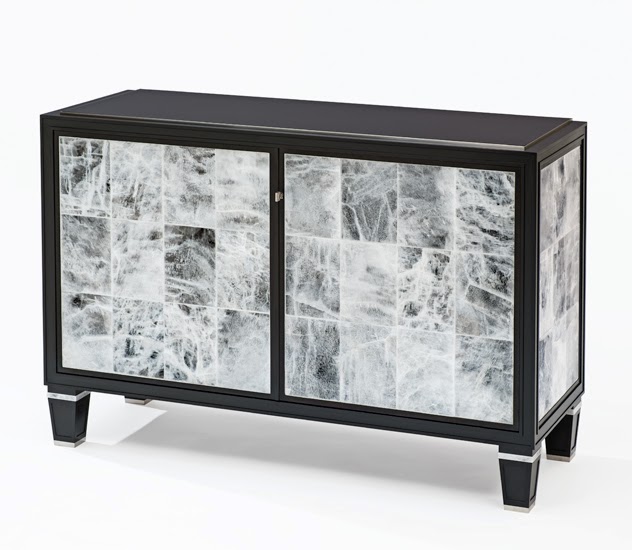
Another stunning Atelier Viollet original, this cabinet is made up of gypsum, ebonized Pear-wood and silvered bronze.
Atelier Viollet has been featured in numerous design publications including New York SPACES, New York Magazine, House & Garden among others. To learn more about them and what they do, please visit AtelierViollet.com. Their Brooklyn-based studio and showroom are available for visitation by appointment only.

Monday, June 18, 2012

No.1 Foster Reeve & Associates, Inc. - Architectural & Ornamental Plaster


Who: Foster Reeve
What: Foster Reeve & Associates, Inc.- Architectural and Ornamental Plaster
Where: New York City + Los Angeles,
services projects nation-wide (and soon to be internationally)
When: Since man began mixing mud to strengthen their buildings...
Oh, and this company has been around just shy of 20 years.

When you meet Foster Reeve, he's an easy going guy. Funny, understated. With a certain charisma for comfort, talking with him easily feels like catching up with an old friend. Then, when you start asking him questions like: 'So Foster, Why Plaster?'-- he is very serious, and very excited.
"You have to understand, I'm a trained painter and a math guy." 
He has a game of computer chess on his desktop screen behind him, the bookshelf above it holding a very worn Le Petit Trianon, Peter Pennoyer and Anne Walker’s recent tour de force Apartments, Townhouses, Country Houses, C. Howard Walker’s A Theory of Mouldings and a slew of natural history magazines. (Walking out of his office, he keeps an enlarged poster of the Classical Orders up on the wall of the adjacent supply room, so he sees them each time he passes by.) Foster reflects affectionately on his days at Parson’s where he received his training in Fine Art.

An FRA Artisan perfects a second layer of sculpture over a first mold.

“I was one of those guys you’d see posted up in any given corner of the MET just copying paintings. Copying, copying… That’s what so much of this work is, actualizing a designers vision through an articulate use of their precedent images and using this decorative moment to do something still proportional, but also thoughtful with the ornament.
“I grew up in the construction trades, always fixing things. Learning how to push a broom is a quintessential skill everyone should start from. And I love geometry. The moment I saw with plaster, was this potential of this inherently simple and beautiful material and all the things it could accomplish geometrically, artistically—has accomplished—and should continue to in design. I’m really an advocate for what it can do, what so many people either didn’t know or forgot it could do. Plaster’s capabilities are endless.”
Custom Plaster Ceiling Ornament, Palmettes + Shallow Dome
And he’s not kidding. Plaster doesn’t mean drywall or caulking glue for that crack in your ceiling. Not like this. Here plaster means: endless sculpture, crown moldings, flat work, ceiling ornamentation, Venetian Plaster (decorative wall finishes), Stuc Pierre (a French plaster alternate to natural cut stone), 
Scagliola Cast in custom crown mold

Stuc Pierre wall and ornamentation
Scagliola (an Italian plaster alternate to marble) and an array of integral colored wall finishes (custom crafted colors and textures made with plaster). I don’t know about you, but I hadn’t know most of those things existed prior to meeting Foster.

“Plaster is a gypsum-based product. You have to understand we ride the fine-line between the construction and interior decorating moment [in building].” Foster notes, “Yet another thing to love about it is that when installed properly, with gypsum to gypsum, plaster is then monolithic with the structure—the building can’t tell it’s separate.” Probably another reason plaster has been used in building for centuries…
An FRA Artisan sculpts a custom capital pre-molding
An FRA Artisan completes a custom overdoor sculpture before it goes under rubber

This company is neither your average artisan nor manufacturer. Yes, they do manufacture their own products in-house, and offer an array of pre-made products—but most everything else they offer is custom. No two pieces are alike—unless he’s used his modern geometric genius to panelize a repetitive mold or pattern and cut the cost of a custom mold in half! The process of creating say, the highly decorative ornament you see below is lengthy. It requires calculating the smallest fragments of an inch to determine an even smaller detail. 

Custom ornamental crown molding with medallions
The shop has engineers on staff that use AutoCAD to produce shop drawings for each molding profile in each room, and while they do that, depending on what the project calls for, the art department will be researching precedent images of what the architect or interior designer wants to see, to then replicate it via sketches or charcoal to submit for approval. (I don’t know about you, but I’m a bit worn-out just thinking about it). 
A newly sculpted rosette with its precedent image
Once a newly derivative conceptual image is approved, the artwork is then uploaded into AutoCAD, on top of the rather generic lines in the computer, and then, viola—it’s all printed out to the proper scale and proportion it should be in the [respective] room.

So, all this hard work, research and intensely creative artwork is done- now you get to start sculpting. That’s right, you’re not finished yet. The artists in Foster Reeve’s Atelier literally put down a piece of Plexiglas on top of a copy if the approved, fully scaled drawing, with another propped up to the side, put some clay down on top of that and begin to map and carve out the drawing- or they just do it by eye. (Mr. Reeve noted they’ve used a variety of clay’s, but right now are really enjoying water clay for this phase). This can take some finesse and series of approvals as well, but once it’s all clear with the designer and client, one of my favorite things happen: they cast a mold.
A rubber mold of a Greek Key detail

Maybe it seems not so exciting, but I think it’s fascinating: They literally make their own rubber, from scratch, layer and pour it over the clay sculpture, making their own mold (a dedicated science in its own right) and let it set until its dry. 

After the rather delicate procedure of taking the rubber off the clay, there is now a rubber mold you can pour any variation of plaster into, let it harden and dry, and again, quite deftly, remove from the rubber (well, not to mention layering in any number of things in the plaster as it’s setting to strengthen it, such as burlap).
An artisan cuts burlap for a cast
And there you have it: a plaster cast.

Often, what happens when a company is strictly a [plaster] manufacturer, is they will use one rubber mold (as described above) to make hundreds of thousands of plaster casts of that one same mold. There are 3 huge downsides to this which just don’t sit well with Foster:

“Well for one, the rubber doesn’t hold that well, so you make a couple hundred of these things and the cast looses all its crispness, its sharp, beautiful detail;” he nods over at an artisan touching up each little blemish on a cast before it’s taken to installation,
Touch up to plaster before installation.
“really, it dumbs-down the mold, makes the character look almost cartoon-ish. Also, nothing is custom in that moment, it’s one of three rosettes you’ve seen before over and over. And, if you’re just churning out molds of one thing and selling them to anyone to stick anywhere, they certainly won’t be proportionally correct!”
Well, you heard it: proportion, thoughtful use of ornament and attention to detail. These are some of the ingredients necessary for a plaster finish that will last for generations to come, and perhaps be restored one day—well, we know that's for sure if you're having Foster Reeve do it for you. If you're working on a one-of-a-kind home of your own that you want to last, I'd say give him a call. 
A custom sculpted crown and cove takes multiple layers of sculpture before a final mold is made.
Beautiful attention to detail that will go under rubber and be molded in plaster to last for generations.

Foster Reeve & Associates, Inc. has worked on projects featured in Robb Report (the 2012 Ultimate Home), Architectural Digest (most recently June 2012's issue) and many other design publications. Foster Reeve himself has now also been published in the recent Perspectives On Design New York, and has more to come in literature documenting keeping the traditional plaster craft alive in 2012. You can learn more about them at www.FRAPLASTER.com, or contact them at the Atelier: NYC: 718.609.0090 - LA: 310.390.5071.