Where: Toronto, Canada
+ services projects all over North America
Richard Carbino is vivacious, fun-loving, always enjoys a good laugh- at first glance you might not guess he was deeply passionate about stone and one of the leading forces behind what is today, home to the largest existing studio of classically trained stone carvers in North America.
Inspired and moved by art and architecture all over Europe and the work of Gian Lorenzo Bernini, Richard pursued his own training as a Journeyman Mason under Danish Master Mason Knud Norgaard in Kingston, Canada.
"It's funny though, aside from my love of the craft, I had a foreman on a job once tell me I talked too much and maybe I should work in sales," Richard laughs, "well..."
On November 11, 1999, their hearts aflutter with hope and optimism, three men gathered and set out on a mission to preserve the history and beauty of an irreplaceable art. Richard Carbino was one of these three, along with David Tyrrell and Lawrence Voaides, who officially founded Traditional Cut Stone, Ltd. Their utter love for stone, art and architecture would not be in vein, they would preserve it's place in architecture and design for as long as they possibly could.
"It was a day to remember, indeed." Says Richard.
 |
| TCS rendering for a stone fountain. |
Traditional Cut Stone, Ltd. specializes in upholding the classical elements of
stone carving in architecture, preserving a certain integrity, honesty and high caliber element in building that isn't as easily found as one might think- they preserve and protect the art in architecture. Not just the final outcome, but the process of its creation.
As we've learned here once before, with Foster Reeve, another advocate of the classical design and creation process, there are numerous components that go into expressing a superlative design correctly. Richard and his team take this no less seriously. For them, however, the preservation of this historically heroic process is necessary as they are in the business of creating history-
 |
| TCS custom Corinthian Capitals made of Indiana Stone adorn these columns. |
"Think about it, stone is the oldest, most widely used building material on the planet. To conquer natural stone- to shape, carve and build with it- it makes you feel like anything is possible. And its inherently organic quality and sense of permanence are both awe- inspiring and humbling at the same time."
 |
| Michelangelo Bust in Carrara Marble |
It's one thing to make sculptural art work out of stone to stand alone, but Richard notes that the combined effectiveness of stones durability and aesthetic enhancement of adorning a building that makes its use in architecture and design so breathtaking. So when I ask him quite simply why, aside from the challenge it provides, stone matters; why is it important to have classically trained artisans and stone carvers participate in architecture and design in 2012, Richard doesn't have to think for a moment-
"For the same reason that opera, classical music and ballet matter. Without the arts there is no culture. Without culture there is no love. Without love, there is no life."
 |
| TCS 20,000 sq ft atelier in Toronto, Canada. |
Customized, hand crafted creations that come out of Traditional Cut Stone's 20,000 square foot atelier in Toronto, Canada are indeed pieces of art. The process each project undergoes is thorough, and fuses the articulation of old methods with a few the newer technologies to help expedite the process.
 |
| TCS phase one of a tympanum. |
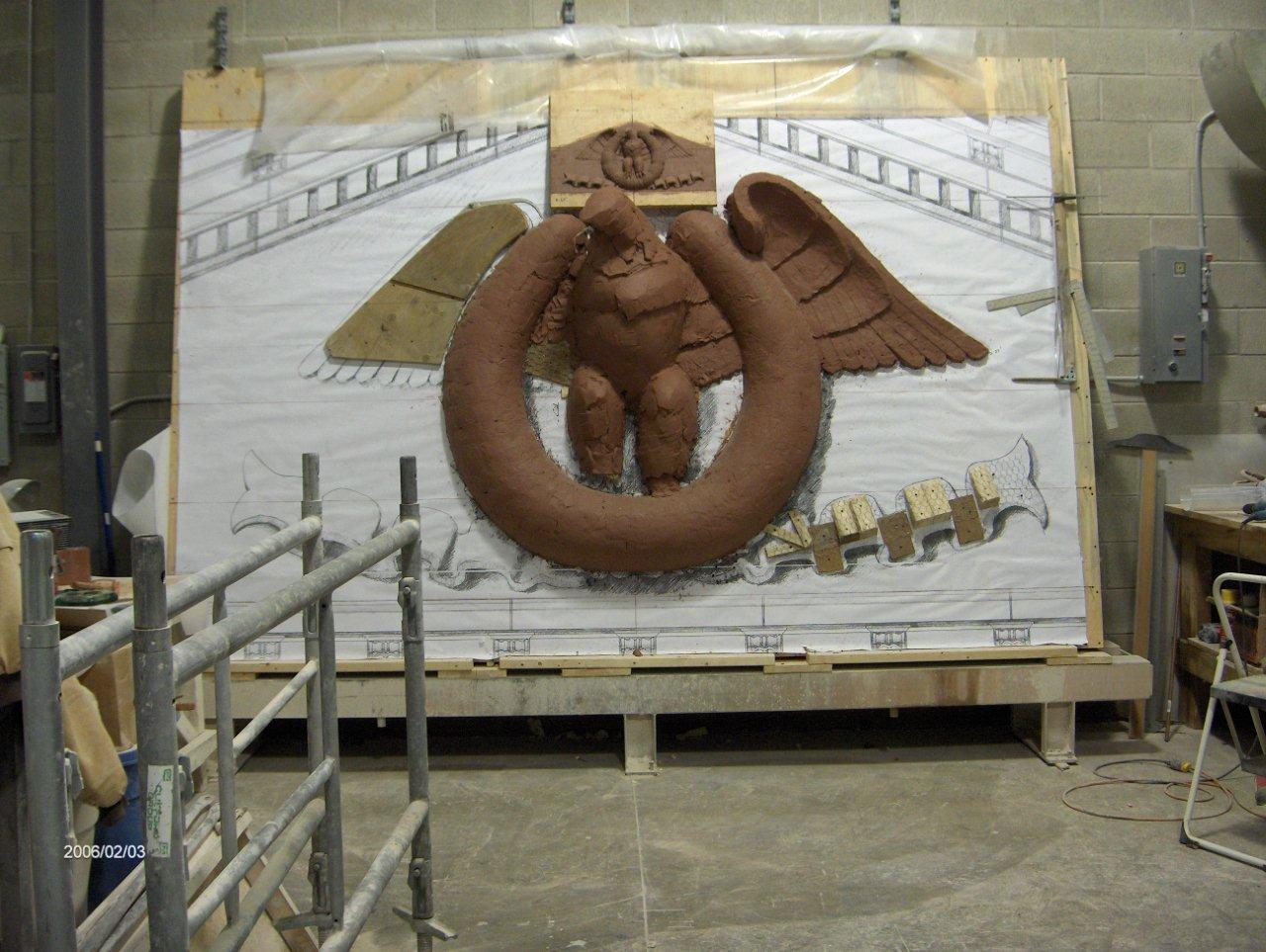
When a client and/or designer comes to Traditional Cut Stone with a project, they bring a vision. This vision is one that is shared with Traditional Cut Stone's team and artists to begin. After an in-depth round of research and sketches (to assist in creating the most historically and artistically correct image possible), the artist will develop sketches into more lush renderings which are then submitted for approval. These drafts may begin on a small scale, but they do also get printed out to their full scale for initial design development to begin.
 |
| The above rendering of a building's tympanum with an eagle sculpture is taken to the next phase, with the image printed to it's actual scale, and the beginnings of it's sculptural actualization. |
 |
| The tympanum's ornamentation and sculpture continues to take shape at it's intended scale. |
 |
| A close up on some of the near complete detailing of the tympanum's eagle and bay leaves sculpture- you can watch a seriously awesome slideshow of the process here as well. |
Also similar to Mr. Reeve's process, when a rendering is approved, a sculptor begins to work out a mock-up of the piece at hand with clay, and later is also molded in plaster. While some of these elements of preparation are being addressed and perfected, Traditional Cut Stone will also work with the design team and artisans to select the right natural stone for the piece. Sometimes, this can be challenging as there is such a wide variety of stones out there to choose from, and depending on the project- be it a balustrade, a specially commissioned bust, a full range of facade ornamentation or a fireplace- selecting this material is crucial. After all, once it's done in stone, it really is there forever.
 |
| An occulus window surround carved in Minnesota Limestone |
"I'd have to say that Stone's are really just like people- some of good character and some of bad character... The trick is knowing which ones to invite to your dinner party." Richard jests.
"It all comes down to fitness for use; it depends on the stone type. Some sandstone's and limestone's are good for exterior use, and some aren't. [Although] my favorites would include: Carrara marble for figurative statuary; and limestone or sandstone for architectural ornamentation."
 |
| TCS artisans hand carve + chisel stone ornamentation. |
When a stone is selected and all of the details of the 3 dimensional clay mock-up have been approved, a plaster cast of the clay sculpture is taken. This plaster cast provides as a fully accurate model for the artisan to work from as they begin stone cutting and carving.
Traditional Cut Stone, is in fact, extremely loyal to the tradition of stone carving as it's been passed down through history. The entire process up until this point remains relatively the same as it was in he 14th Century, with the exception of using AutoCAD to electronically compute dimensions to scale of the final product.
 |
| An air hammer is utilized to smooth out carved details. |
They may also use a CNC (Computer Numerical Control) machine to assist with cutting down extremely large pieces of stone to a geometrically (and proportionally) manageable size to begin the work by hand; or an air hammer to assist with smoothing out sections of a piece of stone. Utilizing today's technology to assist with the ancient process of stone carving with a chisel, mallet and hammer, helps cut down on time once spent on labor intensive activities (like cutting down a massive chunk of stone to the size you need), and leaves that time to be spent focusing on the artistry.
Traditional Cut Stone has actually shown that technology has helped to maintain an age old process that requires no technology at all. While creating architectural details with stone can seem a lengthy process, it seems it should be, for it is the process itself that is preparation for something that will last for generations to come.(If you look up synonyms for 'permanent', you're likely to find phrases such as 'set in stone' for a reason- stone lives on past us).
 |
| The eagle, tympanum and architectural ornamentation are settled into their new home. |
It makes one wonder just how much more time we should be devoting to so many aspects of our lives. Richard, David and Lawrence didn't care about the trends of the times when they gathered together to create Traditional Cut Stone (the use of numerous alternate materials in the 1970's nearly wiped stone off the menu in building) they were devoted to preserving the craft, integrity and process that goes into creating spaces of meaning which we inhabit. These men have created a space for the love of art, materials and architecture can foster one another and grow. It nearly seems overwhelming to think of just how much goes into creating pieces of history now. Alas, Richard reassures me it is not impossible to participate and appreciate art, architecture and stone everywhere:
"Look up! Look around you! Study the architectural stone where you live and wherever you may travel. By doing so you will be paying homage to the men and women that have literally carved mankind's history in stone."
Now this is the sort of underlying philosophy and ethos that actually should be set in stone. Thanks, Richard.