Showing posts with label Custom. Show all posts

Thursday, February 28, 2013

No.9 Appraising The Jewels of the House with Martin Grubman of P.E. Guerin

Who: Martin Grubman
What: P.E. Guerin - Custom Decorative Hardware
When: Since 1857
Where: Founded + Based in New York City
And Today Has Foundries + Showrooms Internationally

It's been said before that 'knowledge is power and convenience is costly.' A wise statement that holds true in everything from the food we eat to the car we buy; and where could this be more true than in the homes we live in? It's one thing to purchase the cheap products, materials or furniture we need to get us through the moment, but it's another to just get sucked into the cycle of purchasing more and more new throw-away's rather than saving, researching and educating ourselves on the best way to invest in the space we want to be in, that will last for the long run. Sure, change is inevitable, but truly thoughtful investments in the home are sure to not only enhance the personal experience of the space, but also it's monetary value. 


A P.E. Guerin Louis XIV hardware compilation.
We've spoken before about the assets of utilizing the truest of true Artisans when designing, drawing, decorating, and building a home/ building. What Artisans bring to the table in both the design process and the final product are both an enrichment in the literal value of a space, and the ability to enhance the artistic expression and personality in architecture and design. When it comes to the multifaceted world of artistic metalwork, it's been said many times that the decorative hardware is something of "the jewels of the house". And in no way could this be more tried and true than in the case of work made by P.E. Guerin, the oldest decorative hardware firm in the U.S. and last living and thriving traditional foundry in New York City.

Spanning 150+ years of existence and four generations, P.E. Guerin maintains every component of the traditional process of artisanal metalwork in decorative hardware, whose precedent example was set by its namesake and renowned talent, French immigrant Pierre Emmanuel Guerin, a pioneer in his craft. Many of Pierre Emmanuel's original work can still be found throughout New York City, and still in all it's luster and quality. So, despite the trends and culture of immediate gratification and now that rules so much of the consumer mindset today, this company has managed to stick to its guns in believing, to its core, that the production of something special that will last you for generations to come, should still be well thought out, intricately detailed and finished with expert precision.

A stellar example of Guerin's abilities, as seen in many top shelter publications today.
  "With the dumbing-down of society in this country, working standards and products become sub-par, and production is less formal;" says Martin Grubman, Vice President and Project Manager at P.E. Guerin, "maybe not by choice, but because we don't know any better anymore."  

Martin Grubman, who has been with P.E. Guerin for over 25 years now, has become a true advocate for the process and the product. 
Martin even noted that in common manufacturing of, say, bathroom hardware or faucetry today, there's been a mass decision somewhere along the line to attempt to alleviate skews and alter knob and lever creation (and their valves) so that each one goes a different direction. This is actually commonly practiced so as to have one less thing to do in production, saving manufacturers costs, but not necessarily creating a product that will last a lifetime. 
"We recently had a homeowner call us, who'd taken over an old family property in Pennsylvania, a house built in 1926, that had Guerin hardware in it," Martin notes, "They sent it to us to have us refinish the items and add a few new valves, then we sent it back to have it re-installed- it looked as incredible as ever. Actually, same thing also happened with an old hotel in San Francisco a few months back. It's all still immaculate."
It's impressive to say the least, and certainly no surprise Martin appreciated this moment in his work with Guerin. Having originally worked in the high-end building industry, Martin had seen a thing or two in the design + build process of high quality homes, and intimately understood the process when he met Andrew Ward, the fourth generation CEO and President of P.E. Guerin.    
A Louis XV Decorative Paumelle, gold-plated hinge
When he saw the difference in custom products versus mass produced products that were selected, ordered and installed in his work in building, he had come to know intimately that quality was far more important than quantity. When Andrew Ward mentioned he needed some help in his shop and studio, and Martin had gone in himself to see the process, he didn't hesitate to start working there part time, going in 3 days week. His work with Guerin quickly became of great interest, and not so long after he began working there full time, he felt right at home joining something of a family of artisans and craftspeople who had all also been with the company for multiple decades. 
Incredible detail on this tiny Lilypad + Dragonfly
"We'll take on someone new from time to time, and if they show aptitude in a certain part of the process, have them apprentice with one of our older artisans who's been with us a long time." Says Martin of the team. "But most of us have been here for decades." 
And P.E. Guerin, like many of the artisans we've spoken with, bring the process of design development and active collaboration to the table as they engage their designers, architects and homeowners in creating the perfect hardware for each and every project. But beyond being simply beautiful, nice 'things' used to decorate a space, they are both high-quality, functional assets, as much as they are a joy to look at, with products ranging from bathroom fittings and fixtures, to custom furniture and furniture hardware. And it's no wonder all of the products that come out of Guerin are meticulous and perfected, they are handled with care by highly trained, master craftspeople who are in fluid communication with one another (and have been for some time).

A photo of the original P.E. Guerin team in front of their [still current] home in
New York City's West Village. A copy of which still as it hangs in their office.
The four-floor building that houses each painstaking, hand-made step of P.E. Guerin's manufacturing and finishing process in New York City's quaint West Village, is also home to their headquarters and a majority of the company's history, having been their prime location since 1892. As you trot up the old wooden stairs you can almost imagine it as it was in decades past. Every nook and cranny of each floor has been carved out to create even the smallest station to customize their work. You can see exactly what this looks like when you take a tour at the famed foundry on Jane street [by appointment only], where clients, prospective clients, students and museum staff alike can call to try and arrange a tour of the shop / studio just for something of a peek into not only a rarely seen world of craftsmanship, but also a look back through time.
This custom Hippo faucetry goes from modeled mock up to priceless perfection.
We had the privilege of having Martin himself give us a tour of the facilities and the process from it's beginning stages all the way back down to the showroom. We couldn't possibly recapitulate all of the details accurately here (there are so many), but a few of our favorite moments certainly include seeing a live bronze pour, during which bronze that is heated to just below 2,000 degrees is poured into their meticulous moulds and cast into what will become someone's immaculate faucetry. The details the cast naturally emerges with are remarkable, and this is even before any of the other fine tuning to come. 

A Guerin Artisan Chases a custom doorknob in their New York Studio.
Jacqueline, one of Guerin's long time Master Artisans hammers away at a clients custom monogram detailed doorknobs.
Which brings us to our next favorite part of the tour- The Chasing. On the second floor of Guerin's long time home is a room of expert chasers- those who sit and hammer out the details (literally) of every last piece of hardware. Using any number of tools with any number of fine tips (imagine steel the shape of a pencil, and in place of a single point at the end, would be any number of small dots, lines, textures or patterns). Hammering these tips onto the flat surfaces and crevices of each product, a new piece of hardware is given remarkable detail and character. 


Some of Guerin's incredible history is sure to be tucked away in their archive.
These details are a result of P.E. Guerin's in-depth design development process, wherein mock-ups of finalized drawings are [often] first carved in wood to be sure scaling, measurements and details are all accurate and approved. If something looks like it could use a shift in design or detailing, Guerin could probably refer any designer to their archive of each and every detail they've cataloged or saved in their library (also something of a treasure to see). They keep some of their stock of wooden mock-ups and some of their precedent and research literature in the archive as well.

Each product may be of a different material, but can also be finished in a myriad of materials and styles. From buffing, polishing or brushing anything from bronze, nickel or pewter, P.E. Guerin informs on the best products for specific use as well as recommended maintenance and care (which is often quite simple). Each of these distinct differences and are part of a selection process that will still ensure a long lasting product, it's more about an educational component to the program, rather than a blind selection and purchase. And in line with the educational moment in P.E. Guerin's tour, Martin also always likes to laugh and quiz any visitors he may have, asking: 
"Do you know what the main difference between brass and bronze is?" Sometimes there are good guesses, but few know the answer: "Brass has more than 12% Zinc, Bronze has less than 12%..." Martin smiles.
A Louis XIV Doorknob with incredible detail.
Martin notes that while they are both Copper compounds, most people will refer to a product or material as Bronze because it sounds 'sexier' or more expensive, and they can charge more for it. Sure, you may note it's likely a yellower tone could indicate Brass and Bronze tends to be a bit redder, but this isn't always the case. For Martin, and P.E. Guerin, it's more about knowing exactly what you're using and how you want to use it, this will actually enhance the value and afford proper care instructions.

Having gotten to know so much more about the process of creating something magnificent that lasts, and also how open so many of these artisans and custom ornamental professionals are to informing their customers, it is a breath of fresh air to know we can get on board and learn as much or little as we like at any time. After all, investments take research, interest and a desire to learn (or even simply, to know what it is we're paying for, and why it may be a good or bad idea). And again, if we're seriously thinking about investing in our homes, what better place to start than with some of the details that top off and complete each space and will make them our own. 

But beyond all the wonderful new insights we've learned and the incredible work we've viewed by Guerin's artisans, if there's one thing Martin Grubman would like to leave us with it is also the reminder: 
"We do everything- Modern, Transitional, every period imaginable, Deco, Nouveau, (after all we did live through that period)... We don't soley specialize in 18th Century ornamentation." Martin speaks of the process, the stock and the custom abilities, "Some people don't realize how tactile it all is, what a treat it is to look at everyday when it's all said and done."
We can't argue with that. When we purchase our first property, we know exactly who to call for the hardware. We think it's well worth saving for.
A whimsical bathroom will get this Swan Basin set in Pewter and Gold.
A fantastic marine and nature inspired basin set from Guerin's recent "Whimsy" collection. 
A fantastic stepped set of Art Deco inspired hardware.
Martin Grubman still works and thrives at P.E. Guerin and can be contacted at their Jane Street offices for an appointment. P.E. Guerin has been seen and written on in a number of publications, including recent articles in Veranda, Hyland, Traditional Home, and many more. To learn more about them, you can visit their website at www.peguerin.com.

Wednesday, October 31, 2012

No.5 A Rare Species - G. Michael Merritt of Merritt Woodwork Shares On A Legacy of Excellence


Who: G. Michael Merritt
What: Custom Architectural Woodwork
When: Since 1972
Where: Based in Ohio, Florida + Connecticut,
Services Projects on Land + Sea, Internationally 

George A. Merritt was an utterly dedicated man- a man that sought perfection above all else. Little did he know that his own personal talents, along with his uncompromising work ethic and high standards of knowledge and quality, would set sparks flying and ignite a unique flame for refined, superlative architectural woodwork.
"His talent was in educating and working with his hands;" Reflects George's son, current Merritt Woodwork CEO G. Michael Merritt, "he always wanted to start his own business, but he didn't know what..."
A Merritt Woodwork hand carved floral ornament.
Always handy, and interested in design, George A. Merritt had also begun training under an Italian master cabinet maker- which soon proved a good fit. Not long after quickly mastering new skills of his own, George A. Merritt and his mentor decided to begin their business in 1971; just the 2 of them providing outstanding custom products. One of their strengths from the start was also the ability to draw. As drawing and sketching provided a unique service to potential clients, George soon became something of a developer. Realizing he could work and engage with designers in a rare way, serving as an interlocutor between the moment an interior designer or architect began describing their ideas and and his ability to sketch them out in the shop. Between he and his mentor, George began providing artisanal abilities to American designers in his humble Mentor, Ohio shop.

Mahogany: egg + dart, Acanthus leaf, ornament
These designers often needed him to put these ideas on paper, drawing by hand, so they could work together to capture the details, have them approved on paper so George could flawlessly move forward with their creation. He would then gladly take these approved drawings to the shop and he and his partner would work their magic in making them real.


A Merritt Woodwork custom carved capital in White Oak.
So the sparks had struck up a flame and the game was on- the vision of a highly focused, quality cabinet and millwork outfit had begun. Yet, as George A. Merritt desired to truly house a solid business, he began looking for other talent to join their team. As he began to hire in the late 70's- early 80's, he could see that those that were truly talented were already of age, which was fine for the   moment... But being a keen and thorough businessman, he'd already pinpointed that there weren't many young people in the business and began to ask himself: 'well what am I going to do in 20 years? I cannot just rely on my sons...' And it was through this foresight he made the executive decision to take the path of teaching and educating to grow the company slowly and meticulously over time. He wanted to find high energy people that genuinely wanted to be there and were interested in the trade. And he did. He began to work with people who grew into their talents and were devoted to the team, turning around higher and higher quality cabinetry and millwork as they went.

Merritt gives this parlor's architectural woodwork detailing a white lacquer. Design by Scott Snyder, Inc.

Down the line, George A. Merritt's mentor and original partner decided he didn't was a bit less interested in the business, and opted to let George take it down the new path it was headed. And so it went, spending the days on the shop floor getting dusty from drawing shop plans and working with wood, and dusting off to spend the evening going to dinner and meeting his future clients and designers, all in an effort to truly build something special.

Hand Carved Mahogany Rosette by Merritt
And he did. Merritt Woodwork has grown into what is today an organization of over 150 highly trained artisans and craftspeople, installers and engineers. They have serviced remarkable projects for some of the design industry's most coveted names- Robert A.M. Stern, Bunny Williams, Scott Snyder and the late Albert Hadley to name a few.
"All of my first jobs were in the shop, since I was in junior high." recalls Michael, "And [my] Dad was very stern, no handouts, no nonsense, everything you got you earned. He laid a very structured foundation and installed a strong work ethic in all of us- had everyone complete a 5,000 hour work-training program when they joined the team." 
After years of watching his father work and grow his company, and slowly becoming more and more involved himself, Michael began to consider that perhaps this really could be something for him to do. There was a huge satisfaction in working with designers to orchestrate the undertaking of a custom woodworking program. Besides, Michael jests,
"After enough time around the smell of sawdust, I think it grows on ya'."
Merritt puts it's masterly finishing touch on this dining room with a white lacquer, design by Scott Snyder, Inc.
Another white lacquered masterpiece; design by Scott Snyder, Inc.
But there's more to it than that. We've had the privilege of seeing Michael in action, making his thorough presentation of wood's possibilities to some of today's most coveted addresses, and he may well be underestimating his own passion for wood in architecture and design. You can tell in his presence and intensity that he demands excellence in craftsmanship , engineering and installation, and nothing less, to bring his clients designs to life.  He alone holds a wealth of knowledge to various wood species and types, custom finishes, veneers, and even which architectural vernaculars and geographic locations might benefit best from various materials. He is just as thorough as we imagine his father might have been.


"I suppose due to my English heritage I've always had an affinity for Mahogany, which carves beautifully." Says Michael, reflecting on some of his personal favorite materials. "And Walnut Cherries and Maple woods are also beautiful American woods; but since so many of these trees have been decimated with so much of them wasted, they are harder to come by in solids. So [we] still use them, more sparingly, for veneers."

After 30 years of building a successful company with a sterling reputation, passing his affinity for strategy, beauty and craftsmanship on to his sons Michael and Keith, George A. Merritt passed in 2001. It was right at a pivotal moment in Merritt Woodwork's company history, having progressed just enough for a new level of expansion, and it was at that time Michael and Keith Merritt decided to grab hold of the reins and let her lead the way.

Merritt stuns with this custom globe with hidden compartments.
Merritt Woodwork has grown from servicing high end residential projects with it's astounding abilities (and even custom creation of home furnishings for their projects) and has also moved into not only retail and corporate environments, but also marine environments. Yes, you heard that right, Merritt Woodwork also provides their talent to enhancing yacht joinery, furnishings and living environments. Michael himself has always been a fan of sea life and saw an interesting opportunity to expand Merritt's abilities there. One of his favorite hallmark projects in this new realm was working on Cakewalk: a mega-yacht of luxury, has been the largest to be built in the U.S. since the 1930's.

Cakewalk: 281 feet long and 2,998 tons is grand indeed.
 "It was really a moment of pride for us," says Michael, "we were very involved with the preliminary development and the outcome was beautiful."

Another one of the many ways Merritt Woodwork has since grown into the unique powerhouse of woodwork it is today, has been in utilizing technology and fusing it with highly trained craftspeople it employs along with other trained artisans as well. (One of their favorite artists Merritt sometimes collaborates with is Master Carver Ian Agrell.) Of course with programs like AutoCAD and various new machines to assist with handling and roughing out large quantities of wood (followed by hand carving and touching up), Merritt Woodwork employs an even more exceptional technological tool to their package of services: climate controlled workshops and vehicles.

Being thorough in every way possible, Merritt is also dedicated to being just as economical with time as they are with detailing. Many millwork outfits can struggle to provide timely delivery on job sites or installations as the seasonal humidity, temperature and geographic location affect the expansion and contraction of wood. Michael has pointed out that if the workshop is finishing detailing a project in Ohio in August for September delivery and installation in New York or California- both the climate of the shop and the project location will affect the size and measurements of the material. The best way to avoid being incorrect on sizing or potentially holding up a schedule because they can't install until the wood goes back to the correct size, is to make it and deliver it in climate controlled environments. This way, when the project is ready for them, they arrive and deliver the pre-completed product via refrigerated vehicle and install it first thing. The result is flawless excellence that lasts for lifetimes to come.

This residence gets a Merritt Woodwork finish with an authentic, rustic use of wood.
So aside from all we know now about what a thorough, comprehensive woodwork experience can be for a space, should one choose to work with an outfit like Merritt; we know just how dynamic even more details of design can be. This company has truly taken the age-old crafts of wood, addressed and premeditated all of it's pros and cons, and found solutions to be able to apply its beauty everywhere. And we're glad- now that we've seen wood and millwork intelligently utilized and applied properly, we can be aware when we're not having it done right.

When we ask Michael finally, if there was anything he would like to leave us with, anything he'd like to say to the world about his craft and company, he pauses thoughtfully and says:
"Really, more than anything, I wish I could energize the enthusiasm for woodwork in trades and design, and encourage it's use. It's a special craft. One that never stops being beautiful."
Thanks, Michael. We totally agree.
Merritt Woodwork utilizes Makore wood to bring this modern residence to life. Architecture by Jeffery Berkus Architects
Merritt Woodwork enriches this lush dining area with cerused White Oak. Design by Scott Snyder, Inc.
Merritt Woodwork has worked on projects featured in Architectural Digest, Robb Report, Bunny Williams' Point of View: Three Decades of Decorating Elegant and Comfortable Houses, and many more. You can learn more about them at www.merrittwoodwork.com, or contact their headquarters in Ohio: 440.220.7816.

Sunday, September 30, 2012

No.4 Treating the Room Right With Robin Feuer of The Ruffled Window


Who: Robin Feuer
What: The Ruffled Window - Custom Drapery Workroom
When: Since the year 2000
Where: The Tri-State Area and Beyond
 
Always delightful and dressed to the nines, Robin Feuer generally lights up the room with her optimism, warm smile and playful New York accent; so perhaps it's no surprise she would wind up in a career where she literally illuminates rooms everywhere. When Robin discovered she had more than what it took to craft highly customized window treatments she went on to create what is now one of the industry's most coveted to-the-trade-only, custom drapery workroom's.
TRW custom drapes enrich a residence's sitting room. 

When Robin's grandmother immigrated from Russia in the 1920's she brought her art, talent and high design standards with her- creating highly sought after custom couture dresses for the next two decades. Naturally, her mother, and later she too, was raised immersed in fashion, sewing and fabrics, learning unparalleled attention to detail and craft. This matrilineal apprenticeship fit nicely for Robin as she grew to enjoy and master her own designs. So when I ask her why drapes and window treatments (You should all know by now I always must know how one winds up in such a specialized niche of an already niche market), she laughs:
"Oh totally by accident! I was a menswear and specialty children's designer for years." Reflects Robin. "I went to F.I.T. for Fashion Design and later on designed textiles and home furnishings. So a family member of mine who is an interior designer called me one day with a really difficult window treatment she thought I may be able to help her with."
"I said sure and wound up having a ball!"
 
TRW Installers securing hardware.
And so in the year 2000 The Ruffled Window was born. As it turns out, having a background in fashion, textiles and tailoring gave Robin a huge advantage in her new trade- she found plans weren't so difficult to navigate and was able to easily sidestep some of the large architectural issues that might arise in an a room's production. What's more is the ease that came with conducting an installation on site; after years in fashion, the attention to detail and ability to be meticulous under pressure was nothing short of the norm. 

"I get to work in these gorgeous homes, with beautiful fabrics and with some incredibly talented people." says Robin, not minding a moment of the stress "I love what I do!"

An elegant treatment by The Ruffled Window, interior design by David Kleinberg Design Associates.
After working on her first project accidentally and deciding she would and could do more with window treatments, The Ruffled Window began doing mostly retail projects. However, the more Robin worked with interior designers the more she began to thrive on this new aspect of design. Project to project, Robin was referred to a big interior designer who wanted to try her services on a high end residential project- and this was where it all came together. Both Robin and the designer were able to collaborate and thrive on detail, and in ways many retail projects might not call for, and this was where Robin knew she was onto something.

"Interior designers really do have a vision, and I think that generally when we work together they really appreciate the professionalism, efficiency and attention to detail we bring. We contribute to their vision and make the process go more smoothly."
A Ruffled Window seamstress + artisan preps fabric in the workroom
The workroom, where The Ruffled Window conducts the full preparation and customization of their treatments- be it creating a mock-up of motorized shades; crafting, finishing or gilding their custom hardware (rings, finials, curtain rods); hand stitching an endless array of drapery and curtains; or upholstering custom items- is always bustling with activity. It has been noted before that interior designers understand fabrics and treatments, and great designers especially, know that curtains should hang like a gown, or quite simply how various fabrics should be treated (steamed, pressed, lined etc)- every member of Robin's team understands this as well, and has often been trained by Robin herself.
A Ruffled Window Artisan hand stitches decorative lace drapes in the workroom.
 In fact The Ruffled Window goes to such painstaking lengths as to hand stitch many treatments, as well as coming up with ingenious ways to craft the shape a drape should take. (Once they hand stitched a light chain-mail into the bottom hem of a delicate chiffon drapery so as to have it hang properly and keep its form).
An NYC penthouse gets a custom upholstered column

This often includes a fabrics pre-treatment, mock up, hand detailing and treatment again before an installation. When all of the design specifications are approved, details arranged and fabrics selected with the interior design team, Robin and her team are able to work their
A custom hand-stitched shade in progress.
magic. The effect is often subtle but making all the difference in the world to the end result, lasting quality and ambiance of a room. Especially if your home is being designed to suit your every need and bit of character, be it modern, classical or nouveau traditional, there is likely to be a difficult moment in the design that only a highly trained professional could address properly. Be it having customized motorized shades or drapes, specially cut blinds or a very particular installation...
"We specialize in those hard-to-treat areas and windows," notes Robin, "the detailing should be seamless."
Custom circular blinds
 But really, when you think about it, why shouldn't every inch of a room in the home you are having specially designed for you, your life, needs and desires, be this customized? Investing in the expression of your home through design wouldn't be the same if it were low quality and only partially thought through; which is why companies and trades like this one make such a difference- they are helping dress the room, treating it with the TLC it needs.

With all her knowledge and experience, it's no surprise that some of the biggest names in interior design have Robin on speed dial- The Ruffled Window knows how to treat a room right. And in addition to being pleased she stumbled upon the the custom drapery niche of the high end design world, we're confident to say it probably doesn't hurt that Robin also brings her charisma and warm, positive energy in tow to any project she takes on.
 
"It's funny," Robin smiles, "I've always said [and really do believe] that having a room or window without a treatment is like going to a black tie ball with no lipstick!"
And ain't that the truth. Down to the last column, pillow, headboard and window, there aren't enough ways to craft and treat elements of our homes with sophistocation and quality care so they last a lifetime. If the eyes are the window to the soul and the windows are the soul of a room, then surely they deserve the attention. I don't know about you, but I just might put Robin Feuer and The Ruffled Window on speed dial myself.
The Ruffled Window works their magic with custom drapery + gilded detailing in this David Kleinberg Design Associates design.
Classic meets modern in this custom treated stairwell. Interior Design by David Kleinberg Design Associates.

Robin Feuer is the CEO and owner of The Ruffled Window. She has received numerous awards as a fashion designer and superlative recognition as a custom draper. The Ruffled Window's workroom is located in Engelwood, New Jersey and they service projects everywhere. You can contact them at: 201.439.9799


Friday, August 31, 2012

No.3 Written In Stone- Richard Carbino Talks Classical Stone Carving Today with Traditional Cut Stone


Who: Richard Carbino
What: Traditional Cut Stone, Ltd.
When: Since the Earth was created, and Man first carved stone
Where: Toronto, Canada 
+ services projects all over North America


Richard Carbino is vivacious, fun-loving, always enjoys a good laugh- at first glance you might not guess he was deeply passionate about stone and one of the leading forces behind what is today, home to the largest existing studio of classically trained stone carvers in North America. 

Inspired and moved by art and architecture all over Europe and the work of Gian Lorenzo Bernini, Richard pursued his own training as a Journeyman Mason under Danish Master Mason Knud Norgaard in Kingston, Canada.
"It's funny though, aside from my love of the craft, I had a foreman on a job once tell me I talked too much and maybe I should work in sales," Richard laughs, "well..."
On November 11, 1999, their hearts aflutter with hope and optimism, three men gathered and set out on a mission to preserve the history and beauty of an irreplaceable art. Richard Carbino was one of these three, along with David Tyrrell and Lawrence Voaides, who officially founded Traditional Cut Stone, Ltd. Their utter love for stone, art and architecture would not be in vein, they would preserve it's place in architecture and design for as long as they possibly could. 
"It was a day to remember, indeed." Says Richard.

TCS rendering for a stone fountain.
Traditional Cut Stone, Ltd. specializes in upholding the classical elements of 
stone carving in architecture, preserving a certain integrity, honesty and high caliber element in building that isn't as easily found as one might think- they preserve and protect the art in architecture. Not just the final outcome, but the process of its creation.

As we've learned here once before, with Foster Reeve, another advocate of the classical design and creation process, there are numerous components that go into expressing a superlative design correctly. Richard and his team take this no less seriously. For them, however, the preservation of this historically heroic process is necessary as they are in the business of creating history-
TCS custom Corinthian Capitals made of Indiana Stone adorn these columns.

"Think about it, stone is the oldest, most widely used building material on the planet. To conquer natural stone- to shape, carve and build with it- it makes you feel like anything is possible. And its inherently organic quality and sense of permanence are both awe- inspiring and humbling at the same time."


Michelangelo Bust in Carrara Marble
It's one thing to make sculptural  art work out of stone to stand alone, but Richard notes that the combined effectiveness of stones durability and aesthetic enhancement of adorning a building that makes its use in architecture and design so breathtaking. So when I ask him quite simply why, aside from the challenge it provides, stone matters; why is it important to have classically trained artisans and stone carvers participate in architecture and design in 2012, Richard doesn't have to think for a moment-

"For the same reason that opera, classical music and ballet matter. Without the arts there is no culture. Without culture there is no love. Without love, there is no life."

TCS 20,000 sq ft atelier in Toronto, Canada.
Customized, hand crafted creations that come out of Traditional Cut Stone's 20,000 square foot atelier in Toronto, Canada are indeed pieces of art. The process each project undergoes is thorough, and fuses the articulation of old methods with a few the newer technologies to help expedite the process. 

TCS phase one of a tympanum.
When a client and/or designer comes to Traditional Cut Stone with a project, they bring a vision. This vision is one that is shared with Traditional Cut Stone's team and artists to begin. After an in-depth round of research and sketches (to assist in creating the most historically and artistically correct image possible), the artist will develop sketches into more lush renderings which are then submitted for approval. These drafts may begin on a small scale, but they do also get printed out to their full scale for initial design development to begin. 

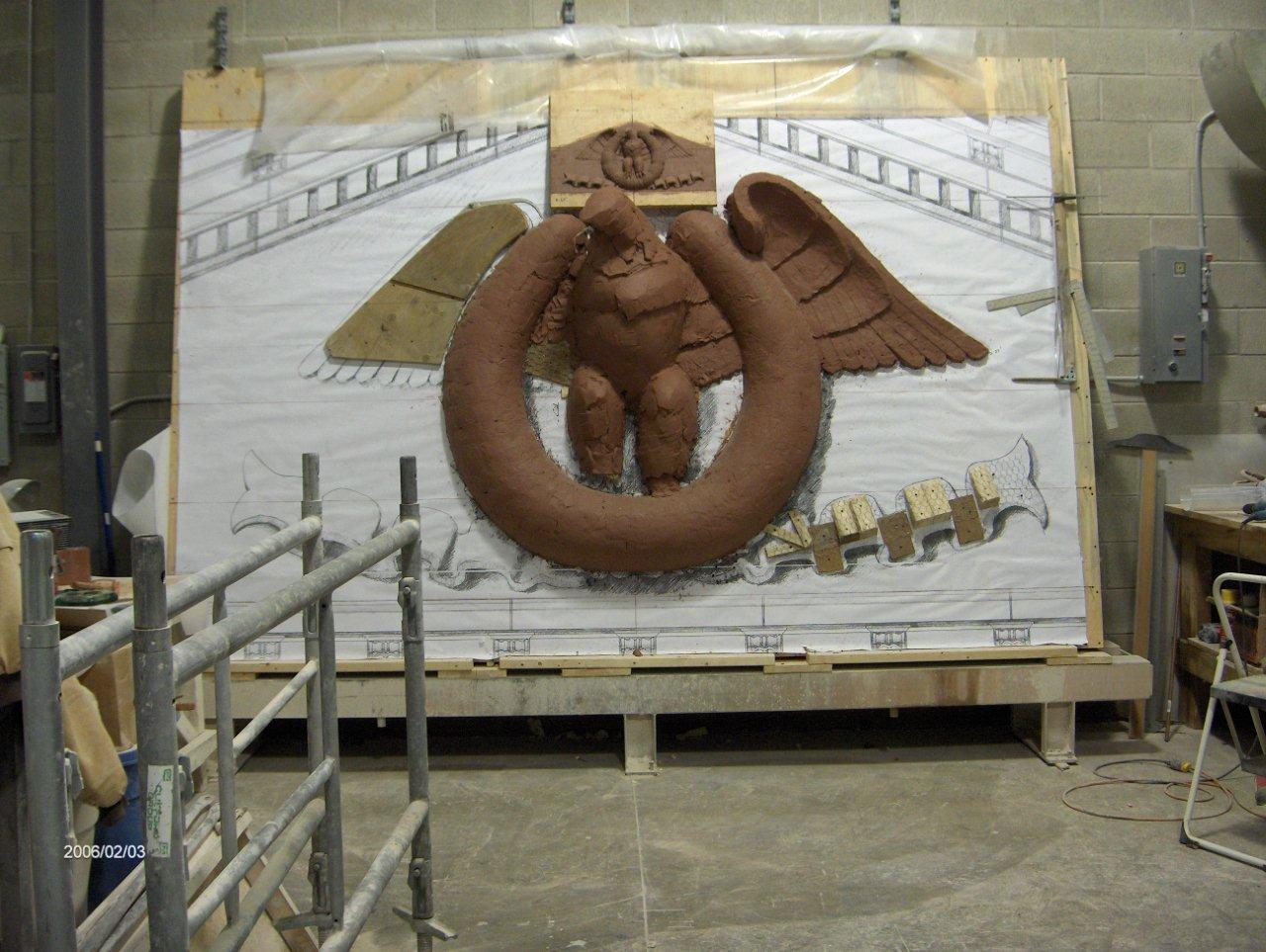
The above rendering of a building's tympanum with an eagle sculpture is taken to the next phase, with the image printed to it's actual scale, and the beginnings of it's sculptural actualization.
The tympanum's ornamentation and sculpture continues to take shape at it's intended scale.
A close up on some of the near complete detailing of the tympanum's eagle and bay leaves sculpture- you can watch a seriously awesome slideshow of the process here as well.

Also similar to Mr. Reeve's process, when a rendering is approved, a sculptor begins to work out a mock-up of the piece at hand with clay, and later is also molded in plaster. While some of these elements of preparation are being addressed and perfected, Traditional Cut Stone will also work with the design team and artisans to select the right natural stone for the piece. Sometimes, this can be challenging as there is such a wide variety of stones out there to choose from, and depending on the project- be it a balustrade, a specially commissioned bust, a full range of facade ornamentation or a fireplace- selecting this material is crucial. After all, once it's done in stone, it really is there forever.
An occulus window surround carved in Minnesota Limestone
"I'd have to say that Stone's are really just like people- some of good character and some of bad character... The trick is knowing which ones to invite to your dinner party." Richard jests. 

"It all comes down to fitness for use; it depends on the stone type. Some sandstone's and limestone's are good for exterior use, and some aren't. [Although] my favorites would include: Carrara marble  for figurative statuary; and limestone or sandstone for architectural ornamentation."

TCS artisans hand carve + chisel stone ornamentation.
 When a stone is selected and all of the details of the 3 dimensional clay mock-up have been approved, a plaster cast of the clay sculpture is taken. This plaster cast provides as a fully accurate model for the artisan to work from as they begin stone cutting and carving.

Traditional Cut Stone, is in fact, extremely loyal to the tradition of stone carving as it's been passed down through history. The entire process up until this point remains relatively the same as it was in he 14th Century, with the exception of using AutoCAD to electronically compute dimensions to scale of the final product. 
An air hammer is utilized to smooth out carved details.
They may also use a CNC (Computer Numerical Control) machine to assist with cutting down extremely large pieces of stone to a geometrically (and proportionally) manageable size to begin the work by hand; or an air hammer to assist with smoothing out  sections of a piece of stone. Utilizing today's technology to assist with the ancient process of stone carving with a chisel, mallet and hammer, helps cut down on time once spent on labor intensive activities (like cutting down a massive chunk of stone to the size you need), and leaves that time to be spent focusing on the artistry.

Traditional Cut Stone has actually shown that technology has helped to maintain an age old process that requires no technology at all. While creating architectural details with stone can seem a lengthy process, it seems it should be, for it is the process itself that is preparation for something that will last for generations to come.(If you look up synonyms for 'permanent', you're likely to find phrases such as 'set in stone' for a reason- stone lives on past us). 

The eagle, tympanum and architectural ornamentation are settled into their new home.
It makes one wonder just how much more time we should be devoting to so many aspects of our lives. Richard, David and Lawrence didn't care about the trends of the times when they gathered together to create Traditional Cut Stone (the use of numerous alternate materials in the 1970's nearly wiped stone off the menu in building) they were devoted to preserving the craft, integrity and process that goes into creating spaces of meaning which we inhabit. These men have created a space for the love of art, materials and architecture can foster one another and grow.  It nearly seems overwhelming to think of just how much goes into creating pieces of history now. Alas, Richard reassures me it is not impossible to participate and appreciate art, architecture and stone everywhere:

"Look up! Look around you! Study the architectural stone where you live and wherever you may travel. By doing so you will be paying homage to the men and women that have literally carved mankind's  history in stone."
Now this is the sort of underlying philosophy and ethos that actually should be set in stone. Thanks, Richard.