Friday, August 31, 2012

No.3 Written In Stone- Richard Carbino Talks Classical Stone Carving Today with Traditional Cut Stone


Who: Richard Carbino
What: Traditional Cut Stone, Ltd.
When: Since the Earth was created, and Man first carved stone
Where: Toronto, Canada 
+ services projects all over North America


Richard Carbino is vivacious, fun-loving, always enjoys a good laugh- at first glance you might not guess he was deeply passionate about stone and one of the leading forces behind what is today, home to the largest existing studio of classically trained stone carvers in North America. 

Inspired and moved by art and architecture all over Europe and the work of Gian Lorenzo Bernini, Richard pursued his own training as a Journeyman Mason under Danish Master Mason Knud Norgaard in Kingston, Canada.
"It's funny though, aside from my love of the craft, I had a foreman on a job once tell me I talked too much and maybe I should work in sales," Richard laughs, "well..."
On November 11, 1999, their hearts aflutter with hope and optimism, three men gathered and set out on a mission to preserve the history and beauty of an irreplaceable art. Richard Carbino was one of these three, along with David Tyrrell and Lawrence Voaides, who officially founded Traditional Cut Stone, Ltd. Their utter love for stone, art and architecture would not be in vein, they would preserve it's place in architecture and design for as long as they possibly could. 
"It was a day to remember, indeed." Says Richard.

TCS rendering for a stone fountain.
Traditional Cut Stone, Ltd. specializes in upholding the classical elements of 
stone carving in architecture, preserving a certain integrity, honesty and high caliber element in building that isn't as easily found as one might think- they preserve and protect the art in architecture. Not just the final outcome, but the process of its creation.

As we've learned here once before, with Foster Reeve, another advocate of the classical design and creation process, there are numerous components that go into expressing a superlative design correctly. Richard and his team take this no less seriously. For them, however, the preservation of this historically heroic process is necessary as they are in the business of creating history-
TCS custom Corinthian Capitals made of Indiana Stone adorn these columns.

"Think about it, stone is the oldest, most widely used building material on the planet. To conquer natural stone- to shape, carve and build with it- it makes you feel like anything is possible. And its inherently organic quality and sense of permanence are both awe- inspiring and humbling at the same time."


Michelangelo Bust in Carrara Marble
It's one thing to make sculptural  art work out of stone to stand alone, but Richard notes that the combined effectiveness of stones durability and aesthetic enhancement of adorning a building that makes its use in architecture and design so breathtaking. So when I ask him quite simply why, aside from the challenge it provides, stone matters; why is it important to have classically trained artisans and stone carvers participate in architecture and design in 2012, Richard doesn't have to think for a moment-

"For the same reason that opera, classical music and ballet matter. Without the arts there is no culture. Without culture there is no love. Without love, there is no life."

TCS 20,000 sq ft atelier in Toronto, Canada.
Customized, hand crafted creations that come out of Traditional Cut Stone's 20,000 square foot atelier in Toronto, Canada are indeed pieces of art. The process each project undergoes is thorough, and fuses the articulation of old methods with a few the newer technologies to help expedite the process. 

TCS phase one of a tympanum.
When a client and/or designer comes to Traditional Cut Stone with a project, they bring a vision. This vision is one that is shared with Traditional Cut Stone's team and artists to begin. After an in-depth round of research and sketches (to assist in creating the most historically and artistically correct image possible), the artist will develop sketches into more lush renderings which are then submitted for approval. These drafts may begin on a small scale, but they do also get printed out to their full scale for initial design development to begin. 

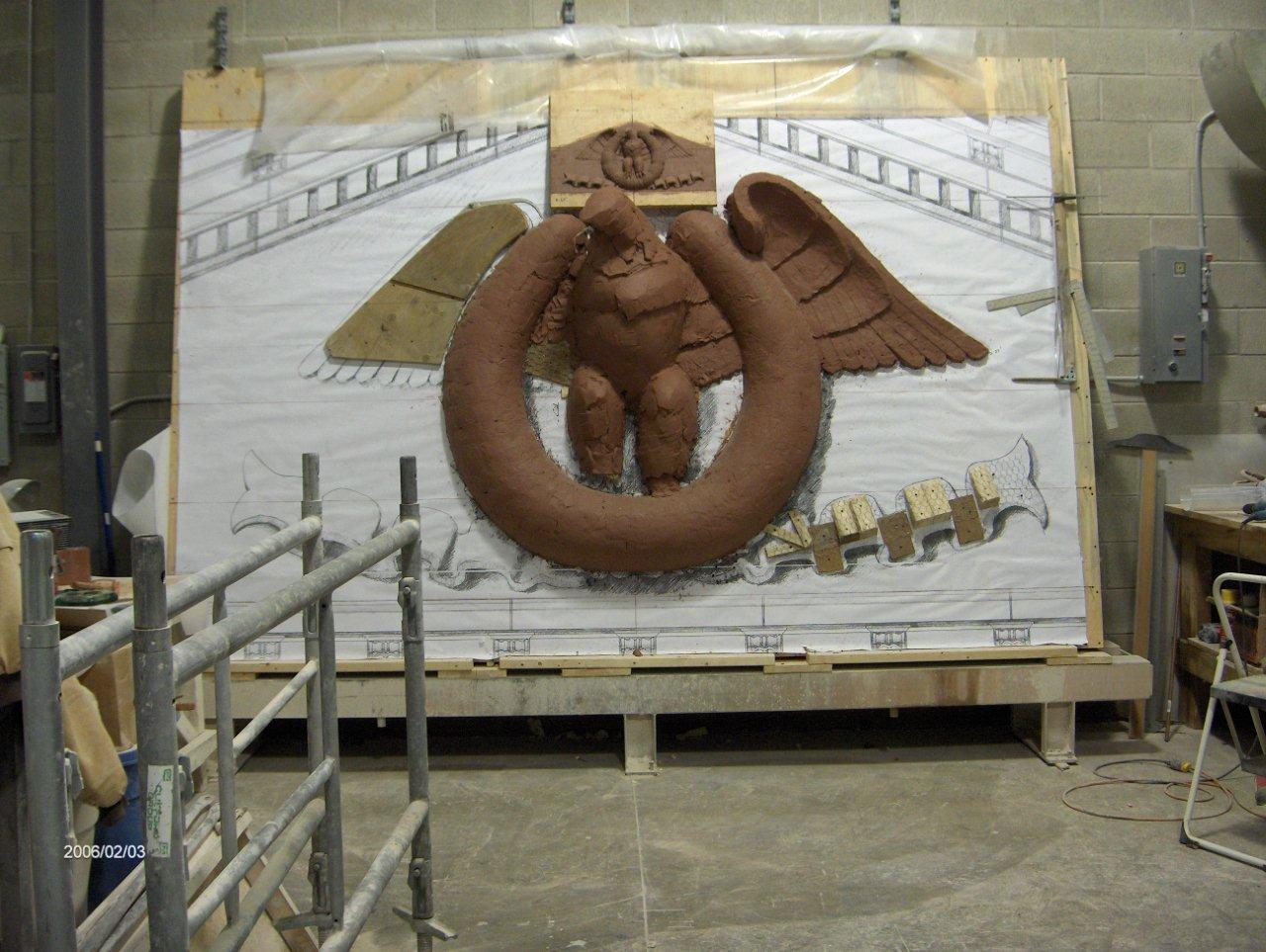
The above rendering of a building's tympanum with an eagle sculpture is taken to the next phase, with the image printed to it's actual scale, and the beginnings of it's sculptural actualization.
The tympanum's ornamentation and sculpture continues to take shape at it's intended scale.
A close up on some of the near complete detailing of the tympanum's eagle and bay leaves sculpture- you can watch a seriously awesome slideshow of the process here as well.

Also similar to Mr. Reeve's process, when a rendering is approved, a sculptor begins to work out a mock-up of the piece at hand with clay, and later is also molded in plaster. While some of these elements of preparation are being addressed and perfected, Traditional Cut Stone will also work with the design team and artisans to select the right natural stone for the piece. Sometimes, this can be challenging as there is such a wide variety of stones out there to choose from, and depending on the project- be it a balustrade, a specially commissioned bust, a full range of facade ornamentation or a fireplace- selecting this material is crucial. After all, once it's done in stone, it really is there forever.
An occulus window surround carved in Minnesota Limestone
"I'd have to say that Stone's are really just like people- some of good character and some of bad character... The trick is knowing which ones to invite to your dinner party." Richard jests. 

"It all comes down to fitness for use; it depends on the stone type. Some sandstone's and limestone's are good for exterior use, and some aren't. [Although] my favorites would include: Carrara marble  for figurative statuary; and limestone or sandstone for architectural ornamentation."

TCS artisans hand carve + chisel stone ornamentation.
 When a stone is selected and all of the details of the 3 dimensional clay mock-up have been approved, a plaster cast of the clay sculpture is taken. This plaster cast provides as a fully accurate model for the artisan to work from as they begin stone cutting and carving.

Traditional Cut Stone, is in fact, extremely loyal to the tradition of stone carving as it's been passed down through history. The entire process up until this point remains relatively the same as it was in he 14th Century, with the exception of using AutoCAD to electronically compute dimensions to scale of the final product. 
An air hammer is utilized to smooth out carved details.
They may also use a CNC (Computer Numerical Control) machine to assist with cutting down extremely large pieces of stone to a geometrically (and proportionally) manageable size to begin the work by hand; or an air hammer to assist with smoothing out  sections of a piece of stone. Utilizing today's technology to assist with the ancient process of stone carving with a chisel, mallet and hammer, helps cut down on time once spent on labor intensive activities (like cutting down a massive chunk of stone to the size you need), and leaves that time to be spent focusing on the artistry.

Traditional Cut Stone has actually shown that technology has helped to maintain an age old process that requires no technology at all. While creating architectural details with stone can seem a lengthy process, it seems it should be, for it is the process itself that is preparation for something that will last for generations to come.(If you look up synonyms for 'permanent', you're likely to find phrases such as 'set in stone' for a reason- stone lives on past us). 

The eagle, tympanum and architectural ornamentation are settled into their new home.
It makes one wonder just how much more time we should be devoting to so many aspects of our lives. Richard, David and Lawrence didn't care about the trends of the times when they gathered together to create Traditional Cut Stone (the use of numerous alternate materials in the 1970's nearly wiped stone off the menu in building) they were devoted to preserving the craft, integrity and process that goes into creating spaces of meaning which we inhabit. These men have created a space for the love of art, materials and architecture can foster one another and grow.  It nearly seems overwhelming to think of just how much goes into creating pieces of history now. Alas, Richard reassures me it is not impossible to participate and appreciate art, architecture and stone everywhere:

"Look up! Look around you! Study the architectural stone where you live and wherever you may travel. By doing so you will be paying homage to the men and women that have literally carved mankind's  history in stone."
Now this is the sort of underlying philosophy and ethos that actually should be set in stone. Thanks, Richard.


Monday, July 30, 2012

No.2 Mixing It Up with Dana Berkowitz of Hacienda Design Studio


Who: Dana Berkowitz
What: Hacienda Design Studio - Cement Remixed
Where: Nation-Wide 
(and soon to be Internationally)
When: They launched just this year, and are already on fire


One afternoon in Yucatan's Historic District of Merida, Mexico, not so long after the last hammer and drill were packed up and the final contractor left, Dana Berkowitz sat in the uncanny quiet of her newly restored mansion drumming her fingers together slowly. Sitting on the edge of the couch, unsure how to relax just yet, she realized she'd done it, she'd accomplished her dream of restoring her very own beautiful, historic home in Mexico. The 1840's carriage house she'd bought in ruins just a few years before was now her very own pristine, restored historic home. Her drumming fingers came to a stop. 
"I literally remember looking around and the first and only thing I could think of was: now what?"
The restored Yucatan home with original cement floors
Dana's gaze landed directly on the colorful cement tile floor in front of her. She'd looked at it a million times, it was, afterall, the only part of the original house from the 1840's that was completely in-tact among the ruins when she bought it. She'd always enjoyed the colors and how the cool, smooth cement made sense in Mexico's hot, tropical weather... Then Dana looked a bit closer. And well, the rest, they could say, remixed history.


Being intrigued by the beauty and durability of the tiles in her own home, and what she was noticing more and more in her surroundings, Dana began to do her research. Over two centuries ago cement tile made its way from Europe (Dana notes, most likely France) to Mexico where it grew in popularity and was quickly utilized as a regular part of building and decoration.  
Cement floors during restoration in Yucatan
Making a mental note of cement tile around Merida and beginning to visit multiple shops where cement tile was made, she found that the utterly versatile and durable material her floors were made of was relatively simple and straight forward to produce, and even better, it was green. 
"Not only did the tile in my 170 year old house last nearly two centuries, but during the restoration, ceilings and walls were demolished right on top of the unprotected cement floors. When the rubble was carted away the floors were polished and still looked fantastic. And then I find out that on top of all of this: it's eco-friendly and LEED certified."

As the pebbles of inspiration began taking shape (and color) in Dana's mind she found herself talking to more people about cement tile and eventually asking some of the local shop and factory owners she was meeting in Mexico if they would work with her on some designs she had brewing. 
Some of HDC's original dried color samples up close. 
Much to her disappointment, not many were interested. Why change and grow? Things are fine as is... Challenged with the mellow thinking that can be found at times outside America's encouraged high-speed individualism, Dana sighed, but did not stop. She kept mulling things over in her head. 


Dana was no stranger to what a refined design aesthetic looked like. Prior to her journey to Mexico she had worked in the architecture + design industry at Pierre Frey, and for ten years as a Senior Design Consultant at Waterworks  in [New York City's] Midtown location. With all the knowledge she had from her years in design, and now as a freshly minted home restoration veteran, 
Espresso from the side
she was starting to see all the elements of design coming together- she was beginning to see a much bigger picture. 


A lover of Mexico and the aesthetic of their traditional tiles, she knew for certain she did not want to replicate what has already been artistically mastered there. However, she did absolutely want to utilize the green, brilliant and simple manufacturing process she had now seen produce a product that could stand the test of time...
"It was very important to me to maintain the ancient handcrafted techniques, but not mimic or repeat the magnificent array of historic patterns already available. [What] I was intent on reinventing [was] the Look of cement tile...
HDS' Sydney pattern adorns new counters at NYC's Salon Hecho.
"I wanted to develop a modern, focused color pallet, going away from the typical rusts, greens and yellows- trying hard to pick the perfect greys, taupes, blues- and create simple modern designs that would work as a collection and fit more contemporary architecture and design. This way any space can have cement tile, not just historic, Spanish colonial spaces."
A playful use of HDS' Monaco pattern adds a jovial sophistication to a children's 'mudroom' and never gets ruined!

Metal frame and template for the Prague pattern
The original craft of making cement tiles, mixing and hand pressing each layer, remains relatively the same today as it did in its beginnings. It is a three part process wherein three cement mixtures are layered atop one another, each hand pressed so all moisture is extracted, and the final tile is let air dry for 21 days. Today the only real difference in this process is the optional use of a hydraulic press, which might expedite the process just a tad.
Cement in various pigments are mixed prior to their pour.
"Once the tile maker pours the cement into its respective sections, he or she places each tile into a hydraulic press with 1700psi to aid in the compression and elimination of moisture." 


A craftsman in Vietnam smooths moisture out of a tiles second layer.  


The final product was a tile that would last a lifetime and sustain a buildings character and story for generations to come, not to mention at an extremely modest price tag for the quality of the product. Dana wondered how many historic American buildings lost their luscious details and decor to time and poor upkeep- 'but imagine if they had been done in cement tile...', she thought, 'Perhaps more of the past could have naturally been preserved...' This was a product too good to let go without trying her hand at it. 
Cannes in Cloud + Sky


While Dana continued to play with colors and design ideas that were growing steadily into a cohesive collection, her search for a factory she could utilize to make her new cement tile vision come to life continued. Now also beginning to plan her trip back to the Big Apple to take on what would soon become Hacienda Design Studio,  Dana booked a meeting with a long time, trusted colleague of hers to get some feedback. She was blown away by the positive response and support of her designs. And she was even more taken when confiding in her colleague how
A craftsman works with custom colors and layers in a tiles frame
hard it'd been just to find a place she could utilize for manufacturing, her colleague relayed that in Vietnam they actually had many factories that were utilizing the same techniques she saw used in Mexico to create cement products. And there it was, just the piece of the puzzle she needed to get started. It turns out that a factory half-way across the world from where she had first explored cement tile was making it in the exact same quality, character and technique.


Bruges in Cloud + Thyme
So at this point, Dana had taken a bit of the Old School of the Mexican cement tile craft, designed an entire collection with modern, sophisticated colors and designs, found a top- notch manufacturing facility in Vietnam and still wasn't done earning the already poignant sentiment behind the company's slogan: Cement Remixed. She brought the New School all the more by implementing technology via Hacienda Design Studio's most incisive feature: The Mixer. This is one of my favorite features that truly brings the renewed cement tile vision and energy full circle- everything is customizable. You are not limited to a collection as merely as Dana saw it (granted we definitely like what's there!), you can re-envision it again and again yourself. You can play with the tile/ pattern of your choice, the tile size, the colors in each detail of the patterns you see on the screen (and save them privately or publicly for viewing) and
Bali in Marina, Bark, Cloud, Pebble + Pumpkin
arrange each of them in a different manner, offering a totally different shape to each pattern (or in solid colors, mind you!). This feature allows the collection to expand beyond what is shown and serves as a key tool to the revitalization of cement tile's possibilities to be used anywhere. Thanks to Hacienda Design Studio we all now have a new resource for both residential or commercial decor that is a green product, water and fireproof, can be used indoors and out, for walls, ceilings and beyond (the product's only limitation is in outdoor use in a freeze/thaw climate- it's the only time cracking is a risk); and all for a modest price. The tiles are only the slightest bit thicker than an average ceramic tile, and are better for a buildings overall durability.


HDS cement color samples for a mix + match session
 Whether you yourself are redoing your entry foyer or your architect or interior designer is redoing your summer home or bathroom, The Mixer allows for a premeditated and well thought out design process that inherently gives one the time and space needed to creating a beautiful outcome. It's true that one could feel inspired and get sucked into The Mixer just for fun, but a trained eye might also find a place to successfully create a custom masterpiece all their own. 


Thank goodness Dana took on her lifelong dream of restoring a historic home all her own in Merida; now we can all enjoy and appreciate her journey into a renewed vision for cement tile. I don't know about you, but I can't wait to see what she has in store next!
Left: Provence tile prototype, Right: A cement rug designed with a Provence field and Vienna Border in Pebble, Shadow, Lily, Sky + Cloud.

HDS' Yolanda Lewis shares about finding inspiration everywhere, including stellar photography. Drawn to the movement and colors of the photo [left] she went into The Mixer to create a beauty of her own [right] with HDS' Seattle pattern.


Hacienda Design Studio officially launched itself in January 2012, it's website in May of 2012 and has since been featured in the Stylist Home section of the Huffington Post. Their product is in use in numerous projects still in production and can be seen completed in Salon Hecho's new NYC digs. To order samples, tiles or to learn more about Hacienda Design Studio you can visit them at: www.HaciendaDesignStudio.com or follow their Blog.


Monday, June 18, 2012

No.1 Foster Reeve & Associates, Inc. - Architectural & Ornamental Plaster


Who: Foster Reeve
What: Foster Reeve & Associates, Inc.- Architectural and Ornamental Plaster
Where: New York City + Los Angeles,
services projects nation-wide (and soon to be internationally)
When: Since man began mixing mud to strengthen their buildings...
Oh, and this company has been around just shy of 20 years.

When you meet Foster Reeve, he's an easy going guy. Funny, understated. With a certain charisma for comfort, talking with him easily feels like catching up with an old friend. Then, when you start asking him questions like: 'So Foster, Why Plaster?'-- he is very serious, and very excited.
"You have to understand, I'm a trained painter and a math guy." 
He has a game of computer chess on his desktop screen behind him, the bookshelf above it holding a very worn Le Petit Trianon, Peter Pennoyer and Anne Walker’s recent tour de force Apartments, Townhouses, Country Houses, C. Howard Walker’s A Theory of Mouldings and a slew of natural history magazines. (Walking out of his office, he keeps an enlarged poster of the Classical Orders up on the wall of the adjacent supply room, so he sees them each time he passes by.) Foster reflects affectionately on his days at Parson’s where he received his training in Fine Art.

An FRA Artisan perfects a second layer of sculpture over a first mold.

“I was one of those guys you’d see posted up in any given corner of the MET just copying paintings. Copying, copying… That’s what so much of this work is, actualizing a designers vision through an articulate use of their precedent images and using this decorative moment to do something still proportional, but also thoughtful with the ornament.
“I grew up in the construction trades, always fixing things. Learning how to push a broom is a quintessential skill everyone should start from. And I love geometry. The moment I saw with plaster, was this potential of this inherently simple and beautiful material and all the things it could accomplish geometrically, artistically—has accomplished—and should continue to in design. I’m really an advocate for what it can do, what so many people either didn’t know or forgot it could do. Plaster’s capabilities are endless.”
Custom Plaster Ceiling Ornament, Palmettes + Shallow Dome
And he’s not kidding. Plaster doesn’t mean drywall or caulking glue for that crack in your ceiling. Not like this. Here plaster means: endless sculpture, crown moldings, flat work, ceiling ornamentation, Venetian Plaster (decorative wall finishes), Stuc Pierre (a French plaster alternate to natural cut stone), 
Scagliola Cast in custom crown mold

Stuc Pierre wall and ornamentation
Scagliola (an Italian plaster alternate to marble) and an array of integral colored wall finishes (custom crafted colors and textures made with plaster). I don’t know about you, but I hadn’t know most of those things existed prior to meeting Foster.

“Plaster is a gypsum-based product. You have to understand we ride the fine-line between the construction and interior decorating moment [in building].” Foster notes, “Yet another thing to love about it is that when installed properly, with gypsum to gypsum, plaster is then monolithic with the structure—the building can’t tell it’s separate.” Probably another reason plaster has been used in building for centuries…
An FRA Artisan sculpts a custom capital pre-molding
An FRA Artisan completes a custom overdoor sculpture before it goes under rubber

This company is neither your average artisan nor manufacturer. Yes, they do manufacture their own products in-house, and offer an array of pre-made products—but most everything else they offer is custom. No two pieces are alike—unless he’s used his modern geometric genius to panelize a repetitive mold or pattern and cut the cost of a custom mold in half! The process of creating say, the highly decorative ornament you see below is lengthy. It requires calculating the smallest fragments of an inch to determine an even smaller detail. 

Custom ornamental crown molding with medallions
The shop has engineers on staff that use AutoCAD to produce shop drawings for each molding profile in each room, and while they do that, depending on what the project calls for, the art department will be researching precedent images of what the architect or interior designer wants to see, to then replicate it via sketches or charcoal to submit for approval. (I don’t know about you, but I’m a bit worn-out just thinking about it). 
A newly sculpted rosette with its precedent image
Once a newly derivative conceptual image is approved, the artwork is then uploaded into AutoCAD, on top of the rather generic lines in the computer, and then, viola—it’s all printed out to the proper scale and proportion it should be in the [respective] room.

So, all this hard work, research and intensely creative artwork is done- now you get to start sculpting. That’s right, you’re not finished yet. The artists in Foster Reeve’s Atelier literally put down a piece of Plexiglas on top of a copy if the approved, fully scaled drawing, with another propped up to the side, put some clay down on top of that and begin to map and carve out the drawing- or they just do it by eye. (Mr. Reeve noted they’ve used a variety of clay’s, but right now are really enjoying water clay for this phase). This can take some finesse and series of approvals as well, but once it’s all clear with the designer and client, one of my favorite things happen: they cast a mold.
A rubber mold of a Greek Key detail

Maybe it seems not so exciting, but I think it’s fascinating: They literally make their own rubber, from scratch, layer and pour it over the clay sculpture, making their own mold (a dedicated science in its own right) and let it set until its dry. 

After the rather delicate procedure of taking the rubber off the clay, there is now a rubber mold you can pour any variation of plaster into, let it harden and dry, and again, quite deftly, remove from the rubber (well, not to mention layering in any number of things in the plaster as it’s setting to strengthen it, such as burlap).
An artisan cuts burlap for a cast
And there you have it: a plaster cast.

Often, what happens when a company is strictly a [plaster] manufacturer, is they will use one rubber mold (as described above) to make hundreds of thousands of plaster casts of that one same mold. There are 3 huge downsides to this which just don’t sit well with Foster:

“Well for one, the rubber doesn’t hold that well, so you make a couple hundred of these things and the cast looses all its crispness, its sharp, beautiful detail;” he nods over at an artisan touching up each little blemish on a cast before it’s taken to installation,
Touch up to plaster before installation.
“really, it dumbs-down the mold, makes the character look almost cartoon-ish. Also, nothing is custom in that moment, it’s one of three rosettes you’ve seen before over and over. And, if you’re just churning out molds of one thing and selling them to anyone to stick anywhere, they certainly won’t be proportionally correct!”
Well, you heard it: proportion, thoughtful use of ornament and attention to detail. These are some of the ingredients necessary for a plaster finish that will last for generations to come, and perhaps be restored one day—well, we know that's for sure if you're having Foster Reeve do it for you. If you're working on a one-of-a-kind home of your own that you want to last, I'd say give him a call. 
A custom sculpted crown and cove takes multiple layers of sculpture before a final mold is made.
Beautiful attention to detail that will go under rubber and be molded in plaster to last for generations.

Foster Reeve & Associates, Inc. has worked on projects featured in Robb Report (the 2012 Ultimate Home), Architectural Digest (most recently June 2012's issue) and many other design publications. Foster Reeve himself has now also been published in the recent Perspectives On Design New York, and has more to come in literature documenting keeping the traditional plaster craft alive in 2012. You can learn more about them at www.FRAPLASTER.com, or contact them at the Atelier: NYC: 718.609.0090 - LA: 310.390.5071.